You've probably looked up your Domain Rating or Domain Authority at some point, seen a number, and had no idea what to do with it. That number by itself isn't a strategy. It's a symptom of decisions you've already made, about which pages earned links, which topics built momentum, and which parts of your site nobody outside your team ever references.
The mistake most site owners make isn't ignoring authority. It's treating the score as the goal instead of reading what it's actually telling them about where their content is strong, where it's thin, and where the two don't match up.
Chasing the number directly usually means buying links or running outreach campaigns aimed at nothing in particular. Reading the number first tells you whether you even have a link problem, or whether the content behind your existing links is the thing actually holding you back.
What your authority metrics are actually measuring
Domain Rating (Ahrefs) and Domain Authority (Moz) are both third-party estimates, not numbers Google itself calculates or publishes. Google has said plainly that it doesn't use either metric internally. What both tools are approximating is the same underlying signal Google does care about: how much of the web treats your site as worth linking to, and from how many distinct sources.
That distinction, distinct sources versus raw link count, matters more than the headline score. Backlinko's analysis of 11.8 million search results found that referring domains, the number of unique websites linking to you, correlated more strongly with rankings than any other link metric tested, at r=0.38. A site with 40 links from 38 different domains will typically outrank a site with 200 links concentrated on 12 domains. Volume alone doesn't do the work. Diversity does.
This is also why comparing your score to a generic industry number is close to useless. Ahrefs' own guidance on reading Domain Rating recommends checking the actual sites ranking on page one for your target keywords and using their average DR as your real benchmark, not a number pulled from a "good DR" chart. A DR of 35 might be strong in a local services niche and thin in a competitive B2B software category.
Authority isn't purely a backlink story anymore, either. As AI search tools have taken on more query volume, they've added a second layer: entity and mention signals that don't always come with a clickable link. Being referenced by name in trade press, cited in an industry report, or consistently associated with a topic across multiple platforms now feeds into how both Google's systems and AI answer engines judge whether you're a credible source, even on pages with a modest backlink count. Google's own core update guidance has repeatedly reinforced this same idea since the 2022 helpful content update: it wants to reward firsthand expertise and topical depth, not link volume treated as a proxy for it.
Reading your score. A high authority score with thin, generic content on most pages means your links are propping up content that hasn't earned its ranking on its own merit. A modest score with tightly focused, specific content usually means you have headroom Google would reward if you built the link profile to match. Neither number tells you which situation you're in. The content behind it does.
What to do: a content audit based on your authority profile
Pull your Domain Rating (or Domain Authority) and your top linked pages, then match your site to one of these patterns.
- High authority, thin content. Your homepage or a handful of legacy pages carry most of your backlinks, but the content on those pages hasn't been meaningfully updated in years. Rewrite those pages first. You already have the link equity; you're just wasting it on content that doesn't hold up.
- Low authority, strong niche content. Your content is specific and genuinely useful, but almost nothing links to it. This is a promotion problem, not a content problem. Prioritize outreach and digital PR for your best existing pages before writing more.
- Authority concentrated on a few pages. Most of your links point at one or two assets, like an old tool or a viral post, while the rest of your site sits at near-zero authority. Fix that by building internal links from those high-authority pages into your newer, related content. You're sitting on link equity you haven't distributed.
- Scattered backlinks, no topical clusters. Your links are spread across dozens of unrelated topics with no concentration anywhere. Pick the topic where you already have the most linked pages and build it into a proper cluster before starting a new one elsewhere.
Most sites are a mix of two of these patterns, not one cleanly. Start with whichever pattern is costing you the most traffic on your highest-intent pages, usually the ones tied to a purchase decision rather than general research.
What to do: closing the gap between your authority and your rankings
Once you know your pattern, the next step is deciding whether content or links is the actual bottleneck, because fixing the wrong one wastes months.
- Check whether your top pages are already outranked by lower-authority competitors. If a site with a lower DR than yours consistently beats you for the same keywords, your content is the bottleneck, not your links. Depth, specificity, and firsthand detail are worth more effort right now than another round of outreach.
- Check whether your content matches or exceeds what's ranking, but you're still not showing up. If your content is genuinely more thorough than what's on page one and you're still buried, links are more likely the gap. This is where digital PR and targeted outreach earn their time.
- Strengthen entity consistency alongside backlinks. Make sure your business name, author bios, and topic focus are represented consistently across your site, your Google Business Profile, and any industry directories or press mentions. This is a low-effort task that increasingly supports how AI search systems verify who you are, on top of what it does for traditional trust signals. Our guide on applying E-E-A-T to your content walks through the specifics.
- Use your strongest pages as internal link hubs. Every new piece of content you publish in a related topic should link back to, and receive a link from, your highest-authority page in that cluster. This is the fastest way to raise a new page's visibility without waiting on new external links.
For a deeper look at building topical depth once your authority profile is mapped, our guide to building topical authority covers the content-side work this audit points you toward. If you're working on commercial pages specifically, how authority drives product page rankings covers that narrower case in more depth.
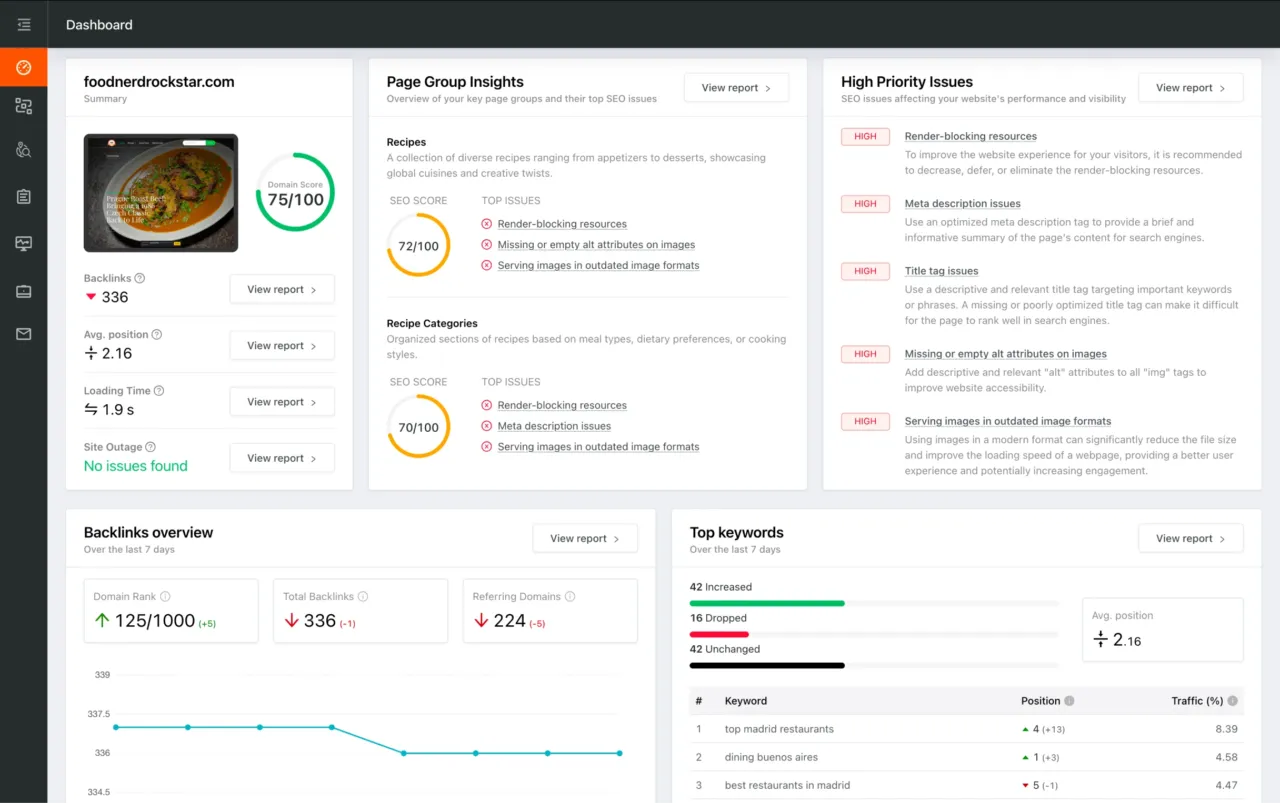
Run your site through the Backlink Checker and SEO Audit Tool to see your current authority profile and which pages are carrying the most link equity. That's the starting list for the audit above, and the fastest way to find out whether you're sitting on unused authority or chasing links you don't actually need yet.