If you've published anything with AI help in the last two years, you've probably wondered whether Google is quietly punishing you for it. The fear is reasonable. It's also mostly wrong, and knowing why matters more than the headline.
Ahrefs analyzed more than 331,000 pages ranking in Google's top 10 results in June 2026 and found that 5.3% of top-3 positions were made up of 100% AI-written content, while 82.2% of top-3 pages had less than half AI content. AI-heavy pages weren't absent from the top of search results. They just weren't dominating it either.
That single data point tends to get read two ways. Either "Google doesn't care about AI, so I can publish anything" or "AI content barely ranks, so I should avoid it entirely."
Both readings miss the actual lesson. The question isn't whether your content was written with AI. It's whether it has the things that make any content rank, and AI-assisted content is far more likely to be missing them.
What actually separates AI content that ranks from AI content that doesn't
Google has said directly, since a February 2023 Search Central update, that "appropriate use of AI or automation is not against our guidelines" and that its systems reward content based on quality signals like experience and originality, not on how it was produced. That's a policy statement, not a ranking guarantee. The gap between the two is where most AI content actually fails.
Originality.ai's ongoing tracking of Google's search results found that AI-generated content made up 19.56% of top results by July 2025, up from under 5% in early 2023. During Google's March 2024 core update, that share briefly dropped to 7.43% before climbing back within months. The dip lines up with what SEOs watched happen in real time: Google's algorithm got sharper at identifying low-effort, mass-produced pages, not at identifying AI itself.
HubSpot's blog is the clearest cautionary case. Analysis from SEO platform Surfer found that HubSpot's keyword rankings in Google's top 3 fell from 138,000 to 30,000, a 78% drop, in the months following the March 2024 core update. The company had built years of topical breadth with articles on everything from cover letters to sales quotes, much of it scaled with AI assistance, and none of it tightly tied to HubSpot's actual expertise in CRM and inbound marketing. The update rewarded depth and authority over volume. HubSpot had volume.
It's worth sitting with that case for a second, because it's not really an AI story. A human writing team that published the same volume of shallow, off-topic content would likely have seen a similar drop. AI just made it cheap enough to publish that much, that fast. The speed is the risk multiplier, not the tool itself.
Quick comparison. Low-AI-content pages received 2 to 3 times more search impressions than very-high-AI-content pages in Ahrefs' June 2026 dataset, even though both groups appeared throughout the top 10. The gap wasn't AI use. It was what was missing around it: original detail, internal linking, first-hand experience, and variation in structure.
What it means if you're running a small site
You don't need a policy against AI. You need a policy against thin, generic content, whether a person wrote it in twenty minutes or a model wrote it in twenty seconds.
For a small business or a solo marketer, the practical risk isn't a manual penalty. It's slower indexing and lower engagement on pages that read like every other page targeting the same keyword. Google's algorithms don't need to detect "AI" as a category. They just need to notice that a page adds nothing a reader couldn't get from the ten other results already ranking.
That's good news, actually. It means the fix isn't "stop using AI." It's the same fix that's applied to bad content since long before AI existed: add something only you know.
This matters more for smaller sites than large ones. A domain like HubSpot's had enough authority built up that it could publish thin pages for years before a core update caught up with it. A newer or smaller site doesn't have that runway. Thin AI content on a site without an established track record tends to show its weaknesses faster, both in indexing and in how long it takes to rank at all.
What to do: a 10-minute self-audit for your AI content
Before you publish anything AI-assisted, run it through these checks:
- Originality test. Does the page say something the top 3 competing results don't already say? If you removed the intro and conclusion, would a reader learn anything specific?
- First-hand detail. Is there a real example, screenshot, number, or experience from your own business anywhere in the piece? Generic AI drafts almost never include this unless you add it.
- Internal and external links. AI-generated drafts routinely skip both. A page with zero internal links reads as disconnected from the rest of your site, which is exactly how Google's crawlers see it too.
- Structural variation. Scan your last five AI-assisted posts. If they all use the same three-point list format and identical heading structure, that's the pattern search engines start to discount, not because it's AI, but because it's repetitive.
- Fact-check pass. AI models still produce confident, specific-sounding errors. Verify every statistic and claim before it goes live. Our beginner's guide to fact-checking AI-written content walks through exactly how to do this without adding hours to your process.
If a draft fails two or more of these checks, it needs another editing pass before it ships, not a rewrite from scratch. Most AI drafts get 70% of the way to something publishable. The last 30%, the part that actually makes it rank, is the part a person has to add.
What to do: fixing content you've already published
If you've been publishing AI-assisted content for a while, don't wait for a ranking drop to find out which pages are thin. Go through your published AI content now:
- Pull your lowest-performing pages by organic impressions over the last six months.
- Cross-reference them against the checklist above. Thin pages usually fail on originality and internal linking first.
- Rewrite the worst offenders with one specific addition each: a real example, a data point from your own site, or a perspective the AI draft couldn't have generated on its own.
- Prioritize by traffic potential, not by how bad the page is. A thin page targeting a high-volume keyword is worth fixing before a thin page nobody's searching for.
- Use our practical guide to removing AI's fingerprints from your content for the editing pass itself. It's built for exactly this cleanup work.
For newer content, build the habit before publishing rather than after. Our guide to creating people-first content covers the editorial process that keeps this from becoming a recurring fire drill.
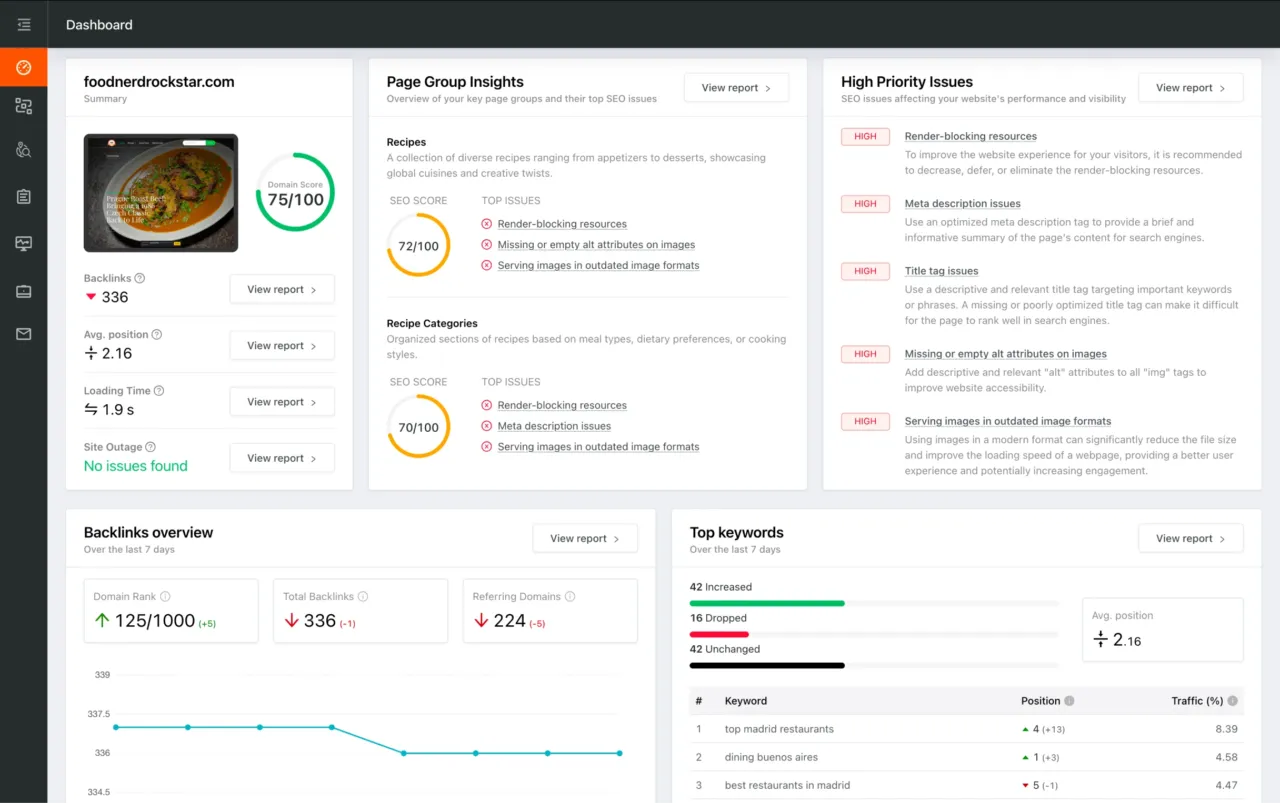
Run your site through the SEO Audit Tool to see how your current pages measure up on the signals that actually predict rankings: content depth, internal linking, and technical health. It won't tell you which pages were written with AI. It will tell you which ones read like every other page on the internet, and that's the number that actually matters.