6 SEO shifts that are already reshaping rankings in 2026
Most sites losing traffic right now aren't doing SEO badly. They're running a 2022 playbook in a 2026 environment. The rules haven't disappeared. They've shifted. This article covers six specific changes already affecting rankings, what independent data shows about each, and what to do about it.
Shift 1: Being cited beats ranking first, as CTR continues decreasing
An Ahrefs study of 300,000 keywords found that when an AI Overview appears, position-one CTR dropped from 0.073 to 0.016 between December 2023 and December 2025.
Seer Interactive's September 2025 research puts the overall organic CTR decline at 61% on queries where AI Overviews are present. On Google's AI Mode, 93% of sessions end without a user clicking any external site.
There is a stabilization signal worth noting. ALM Corp's February 2026 data shows organic CTR on AI Overview queries rebounding from 1.3% to 2.4% in two months. The floor may not keep dropping, but the old search environment isn't coming back.
The more important finding: brands cited inside AI Overviews earn 35% more organic clicks and 91% more paid clicks than brands not cited at all, per GoodFirms and Position Digital.
Being cited is now worth more than ranking first on a query where an AI Overview has taken over the page.
What to do
Stop using raw traffic as the primary KPI for informational content. Conversions, branded search volume, and revenue per visit tell you more.
Prioritize commercial-intent content — comparisons, case studies, pricing guides, tool pages — where AI Overviews appear less often and clicks still happen normally.
For informational content, optimize to earn the citation: a direct answer near the top, structured data, a clear author signal, and fresh statistics that give AI systems a reason to pull from your page.
Shift 2: Brand mentions are the new backlinks for AI visibility
Ahrefs studied 75,000 brands across ChatGPT, AI Mode, and AI Overviews and found that external brand web mentions correlate 0.664 with AI Overview appearances. YouTube brand mentions scored highest of any single factor at 0.737. Brand mentions correlate roughly three times more strongly with AI visibility than backlinks do.
Digital Applied's 2026 research found that distributing content across a range of publications increases AI citations by up to 325% compared to publishing only on your own site. And yet 90% of brands across healthcare, SaaS, and financial services currently have zero AI search mentions. That's an opportunity gap.
What to do
One mention per month in a relevant industry publication compounds quickly. A guest article, a quoted comment in a journalist's piece, a podcast appearance: these are all SEO inputs.
Prioritize YouTube given its 0.737 correlation; even a modest channel with infrequent but substantive videos sends a strong entity signal. Guest posting still works, but the goal has shifted from getting a backlink to building a brand mention in a context AI systems can read.
A quick win: set up Google Alerts for your brand name and your main competitors. See where you're already being discussed. Engaging those conversations is faster than building new relationships from scratch.
Shift 3: Google is one search surface, not the only one
Google holds 73.7% of desktop search volume and nothing is close to replacing it. But search behavior has fragmented in ways that feed back into how AI systems understand your brand. 49% of US consumers used TikTok as a search engine in 2026, rising to 65% among Gen Z, per ALM Corp. Amazon and YouTube each outpace ChatGPT for overall search volume.
The typical 2026 discovery journey: TikTok for awareness, YouTube for reviews, Amazon for pricing, Reddit for honest opinions, an AI assistant for synthesis.
A brand only optimizing for Google is invisible for two or three of those touchpoints. Activity on YouTube, Reddit, and niche communities also feeds into how AI retrieval systems understand your brand as an entity.
What to do
Don't try to be everywhere. Map where your specific audience actually searches, e.g., a B2B software buyer researches differently from a consumer product shopper. Check GA4 referral data to see where non-Google traffic already comes from before investing in any platform.
A YouTube channel with infrequent but substantive content and genuine participation in relevant Reddit communities is a reasonable minimum that signals legitimacy to both AI systems and potential customers.
Shift 4: The unit of SEO competition has shifted from pages to topics
When someone queries an AI search system, it doesn't look for the single best page. It generates multiple related sub-queries and resolves them in parallel before synthesizing a response. A site with one post on "email marketing for small businesses" competes very differently than a site with eight interconnected posts covering the topic and its adjacent questions. The latter has topical authority. The former has one URL.
Semrush data shows interest in semantic SEO growing 12 to 15% year-over-year in 2026. Sites with structured topic clusters appear more consistently in AI-generated responses than sites with isolated pages targeting individual keywords.
What to do
Reframe what keyword research is for.
The output you want isn't "what keyword should I write about?" It's "which topic areas do I have partial authority in, and how do I fill the gaps?"
In Google Search Console, filter for queries where you rank on pages two or three and look for patterns — those are topic areas where a cluster approach could unlock rankings you're already close to.
Before publishing anything new, ask whether it strengthens an existing cluster. And audit your library for orphan pages that target relevant keywords but have no internal links connecting them to a pillar. Those are wasted authority signals you already paid to create.
Shift 5: Informational content without a differentiator is a declining asset
Chartbeat, cited in the Reuters Institute's 2026 Digital News Report, found that Google search traffic to publishers fell 33% globally between November 2024 and November 2025, and 38% in the United States. 73% of B2B websites experienced significant traffic loss over the same period.
Travel guides, recipe sites, how-to content, and product comparison pages face the sharpest exposure. Media executives surveyed by the Reuters Institute expect search referrals to fall a further 43% over the next three years.
The reason is structural. AI systems can now resolve "how to write a cold email subject line" completely without requiring a click. The blog post that used to capture that traffic is competing with something faster and more convenient.
What to do
Stop publishing content that AI can replicate. Shift the editorial question from "what are people searching for?" to "what can we publish that AI cannot produce?"
The honest short list: original data from your own customers or operations, first-person case studies with real numbers, proprietary research, opinions backed by traceable experience, and interactive tools that require user input.
For every informational post you plan, ask: could a capable AI assistant answer this adequately right now?
If yes, the post needs something extra — an original dataset, a real client example with results, a downloadable resource — or it isn't worth the production cost.
Shift 6: SEO automation is raising the floor and changing which skills matter
Searches for "SEO AI agent" grew 285% year-over-year per Ahrefs, and 74% of new web pages now involve AI at some stage of production, per Position Digital.
Keyword clustering, content gap analysis, internal link audits, meta description drafts, crawl analysis — these take minutes now, not hours. If competitors are compressing routine SEO work with AI tools, they're reinvesting that time somewhere. The advantage has shifted from execution capacity to judgment.
The ceiling matters though.
AI-generated content at volume without subject-matter review is precisely what Google's quality systems are built to identify and discount. The same update cycles that cut unhelpful content visibility by 40% target sites that treat automation as a replacement for expertise.
What to do
Use AI to eliminate tasks that don't require judgment, e.g., keyword grouping, title tag variants, content gap identification, flagging pages for refresh.
Reinvest the saved time into work that still requires a human: original reporting, source relationships for digital PR, strategic positioning, and writing where expertise is the actual product.
Those are the inputs that create differentiation. Automating them produces mediocrity.
What these 6 shifts add up to
SEO in 2026 isn't harder than it was three years ago. It's structurally different. The sites losing ground are running on old assumptions: that volume builds authority, that ranking first guarantees traffic, that Google is the only surface that matters.
The practical summary: fewer, stronger pages in tight topic clusters; brand presence on the platforms where your audience actually searches; content AI cannot replicate; automation for the routine, humans for the judgment calls. None of this requires a large team or budget. It requires a different set of priorities.
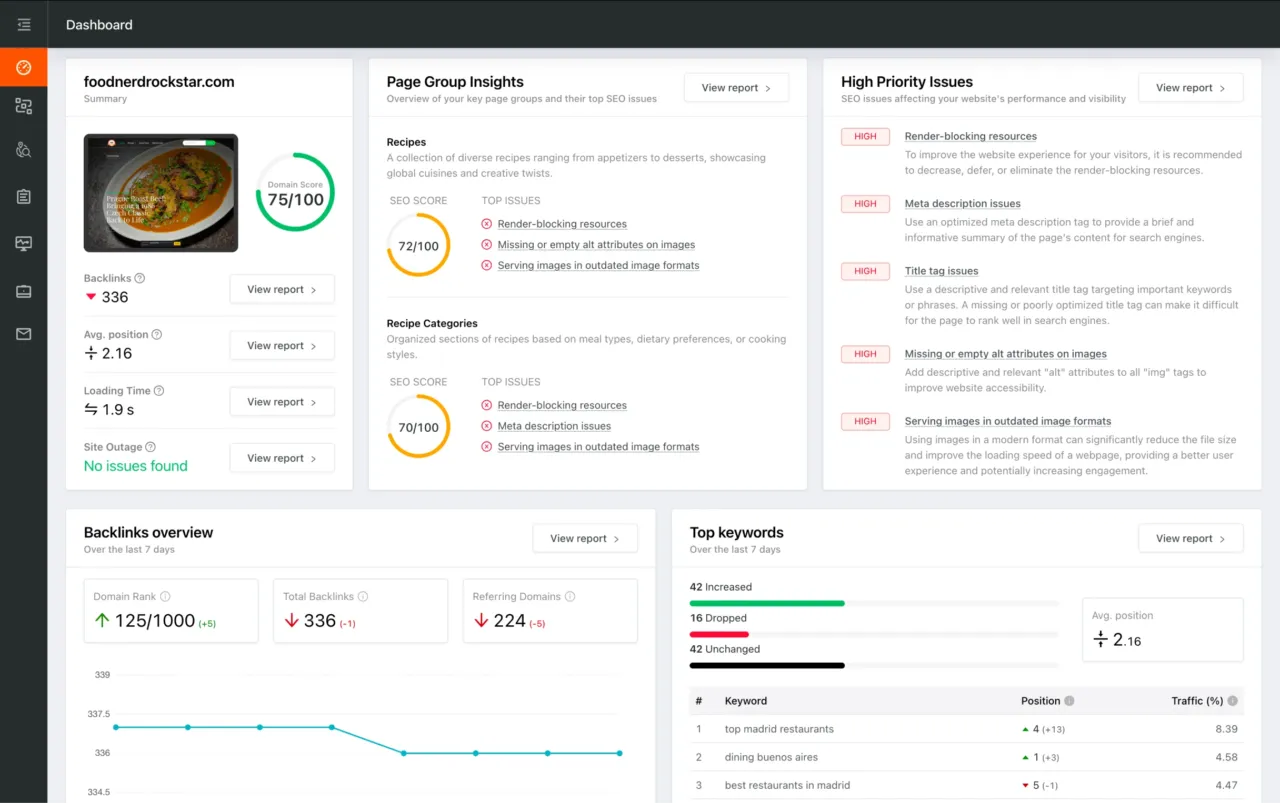
Run a full audit at seositecheckup.com to surface the technical issues most likely holding back your rankings while you work on these strategic shifts.