Customers increasingly use ChatGPT, Google Gemini, Perplexity, Microsoft Copilot, AI Overviews, and other generative search experiences to research problems, compare companies, and choose products or services. Your brand may appear in these answers even when users do not visit your website immediately. Measuring this visibility helps you determine whether AI platforms recognize your brand, which topics connect it to customer needs, how it compares with competitors, and whether the information presented is accurate. A reliable measurement program combines a consistent prompt library with metrics for mentions, citations, prominence, sentiment, accuracy, referral traffic, and conversions. It should evaluate trends over time rather than treating one generated answer as a permanent ranking.
WHAT DOES BRAND VISIBILITY IN AI ANSWERS MEAN?
Brand visibility in AI answers measures how often, how prominently, and in what context a company, product, service, executive, or website appears in responses generated by AI-powered assistants and search experiences.
Visibility may take several forms. An AI answer might recommend your company as a leading option, include it in a comparison, cite your website as an informational source, mention your product as an example, or describe your brand without providing a link. It might also present outdated, inaccurate, neutral, or negative information.
These outcomes should not be counted as if they have equal value. A prominent recommendation is more commercially meaningful than a passing reference near the end of a long answer. A citation to your research may demonstrate content authority without indicating that the assistant recommends your product. A frequent mention can be harmful when the associated information is wrong.
Effective AI visibility measurement should answer the following questions:
• How frequently does the brand appear for relevant customer prompts?
• Is it recommended, compared, cited, or merely mentioned?
• How prominently does it appear within the answer?
• Which competitors appear for the same prompts?
• What sentiment and attributes are associated with the brand?
• Are descriptions of its products, services, pricing, and capabilities accurate?
• Which first-party and third-party sources support the answer?
• Does identifiable AI traffic generate engagement, leads, or revenue?
AI visibility is connected to traditional search visibility, but the two are not identical. Search engine optimization usually measures page-level rankings, impressions, clicks, traffic, and conversions. AI assistants synthesize information into an answer and may influence a customer without producing an immediate website visit.
A complete measurement framework should therefore combine prompt-level AI observations with search analytics, website behavior, customer surveys, and business outcomes.
BUILD A REPEATABLE AI VISIBILITY TESTING PROCESS
Begin by defining the business questions your monitoring program should answer. You might want to understand whether your brand is recognized within a product category, recommended for particular customer needs, cited as an expert source, or accurately described across major AI platforms.
The next step is creating a representative prompt library. Prompts should reflect genuine customer questions across different stages of the decision process.
Include several prompt types:
- Problem prompts: “How can a regional retailer improve inventory forecasting?”
- Category prompts: “What are the best inventory-management platforms for regional retailers?”
- Comparison prompts: “Compare leading inventory tools for a company with 20 locations.”
- Use-case prompts: “Which inventory platform works well with seasonal demand?”
- Transactional prompts: “Which inventory-management solution should a mid-sized retailer choose?”
- Branded prompts: “What are the strengths and weaknesses of Brand A?”
Unbranded prompts are especially important because they show whether an AI system introduces your brand before the user already knows it. Branded prompts remain valuable for evaluating accuracy, positioning, sentiment, and source selection.
Start with approximately 25 to 50 high-value prompts. Group them by topic, audience, location, industry, funnel stage, and intent. Create limited variations when customers commonly express the same need in meaningfully different ways, but avoid filling the dataset with hundreds of nearly identical questions.
Run the same core prompts across the AI platforms most relevant to your audience. These may include ChatGPT, Gemini, Perplexity, Copilot, AI Overviews, and AI Mode. Record whether web retrieval was used because an answer based on current web sources may differ from one generated without a visible search.
For every test, capture:
• Exact prompt
• Platform and visible model or experience
• Date and geographic location
• Signed-in or signed-out status
• Full response or screenshot
• Whether the brand appeared
• Type and prominence of the appearance
• Citations and source URLs
• Competitors mentioned
• Sentiment and descriptive attributes
• Factual errors or outdated claims
Testing conditions should remain as consistent as practical. Personalization, account history, location, platform updates, model changes, and retrieval behavior can influence answers. These variables cannot always be eliminated, but they can be documented.
Do not use follow-up questions from the same conversation for one period and fresh conversations for another. Earlier messages can change the context of later answers. Establish a written testing procedure and apply it consistently.
THE MOST IMPORTANT AI VISIBILITY METRICS
Brand Mention Rate
Brand mention rate is the percentage of monitored answers that mention your company or product.
If your brand appears in 30 of 100 tested responses, its measured mention rate is 30%. This result applies only to the defined platforms, prompts, locations, and testing period. It should not be presented as your brand’s visibility across every possible AI interaction.
Separate branded and unbranded mention rates. A high appearance rate for prompts containing the company name does not demonstrate strong category visibility.
Prompt Coverage
Prompt coverage measures the percentage of important topics or prompt groups for which the brand appears at least once. A brand may have a reasonable overall mention rate but remain absent from high-value categories.
For example, a software company might appear frequently for general project-management questions but never for prompts about construction project management. Coverage reporting makes this strategic gap visible.
AI Share of Voice
AI share of voice compares your brand’s measured appearances with competitor appearances in the same prompt set.
If your company receives 25 mentions and selected competitors receive 75 combined mentions, your share of tracked brand mentions is 25%. This is a visibility comparison within your test—not a measure of revenue, customer count, or total market share.
Review share of voice by platform and topic. A combined score can conceal the fact that your brand performs well in Perplexity but poorly in ChatGPT, or that it appears for educational prompts but not purchase-oriented questions.
Citation Rate
Citation rate measures how often AI answers cite or link to your website. Calculate it as the number of responses containing a first-party citation divided by the total number of monitored responses.
Track mentions and citations separately. Your brand may be recommended without a link, while your article may be cited without the company being recommended.
Also record citation share by page and content type. This reveals whether platforms rely on research reports, guides, documentation, product pages, location pages, or third-party profiles.
Answer Prominence
Prominence evaluates the visibility and role of each appearance. A practical classification system might include:
• Primary recommendation
• First-listed option
• Secondary recommendation
• Comparison subject
• Supporting example
• Cited informational source
• Passing mention
• Cautionary or negative mention
This prevents a minor reference from receiving the same score as a leading recommendation. If your team uses a numerical prominence score, document the rules and apply them consistently.
Sentiment and Attribute Association
Sentiment identifies whether the brand is presented positively, neutrally, negatively, or with mixed language. Attribute analysis records the qualities associated with it, such as affordable, reliable, enterprise-focused, innovative, difficult to use, or suitable for beginners.
Manual review is important. A statement such as “easy to use but limited for large organizations” contains both positive and negative information that a basic sentiment label may miss.
Factual Accuracy
Accuracy measures the percentage of statements about your brand that are correct. Review claims about products, pricing, leadership, locations, availability, policies, integrations, and capabilities.
Maintain a separate error log with severity levels. A minor wording issue should not receive the same priority as an incorrect price, nonexistent service, false safety claim, or outdated product status.
Accuracy is essential because increased visibility is not beneficial when an AI system repeatedly presents misleading information.
CONNECT AI VISIBILITY WITH TRAFFIC AND BUSINESS RESULTS
Prompt testing shows what AI platforms say, but website analytics helps determine whether identifiable appearances contribute to business results.
Track referral sessions from recognized AI sources, landing pages receiving those visits, engagement, lead submissions, registrations, purchases, and revenue where available. OpenAI states that ChatGPT search referral URLs include the parameter utm_source=chatgpt.com, which can support inbound traffic analysis.
Referral data remains incomplete. A user may discover a company in an AI answer, remember its name, and return later through organic search, direct traffic, an advertisement, or another device. Some AI-influenced visits may therefore appear under a different channel.
Support analytics with post-conversion questions such as “How did you first hear about us?” Include AI assistants as an option, but allow customers to provide a more specific response.
Google reports website appearances in AI Overviews and AI Mode through Search Console. Current Search Console reporting also provides dedicated generative AI performance views while retaining the data within overall Search performance. Use these reports alongside Google Analytics to evaluate impressions, traffic quality, engagement, and conversions.
For each reporting period, connect three measurement layers:
Visibility: Did the brand appear, and how prominently?
Engagement: Did users visit the website and interact with the content?
Business impact: Did those interactions generate qualified leads, registrations, purchases, or other meaningful outcomes?
Avoid assigning a financial value to every mention without supporting evidence. AI visibility can influence awareness and later behavior, but a generated appearance does not automatically produce a measurable conversion.
HOW TO REPORT AND IMPROVE AI VISIBILITY OVER TIME
Create a baseline before making major changes. Report results by platform, topic, prompt type, audience, location, and funnel stage. This provides a clearer diagnosis than one portfolio-wide percentage.
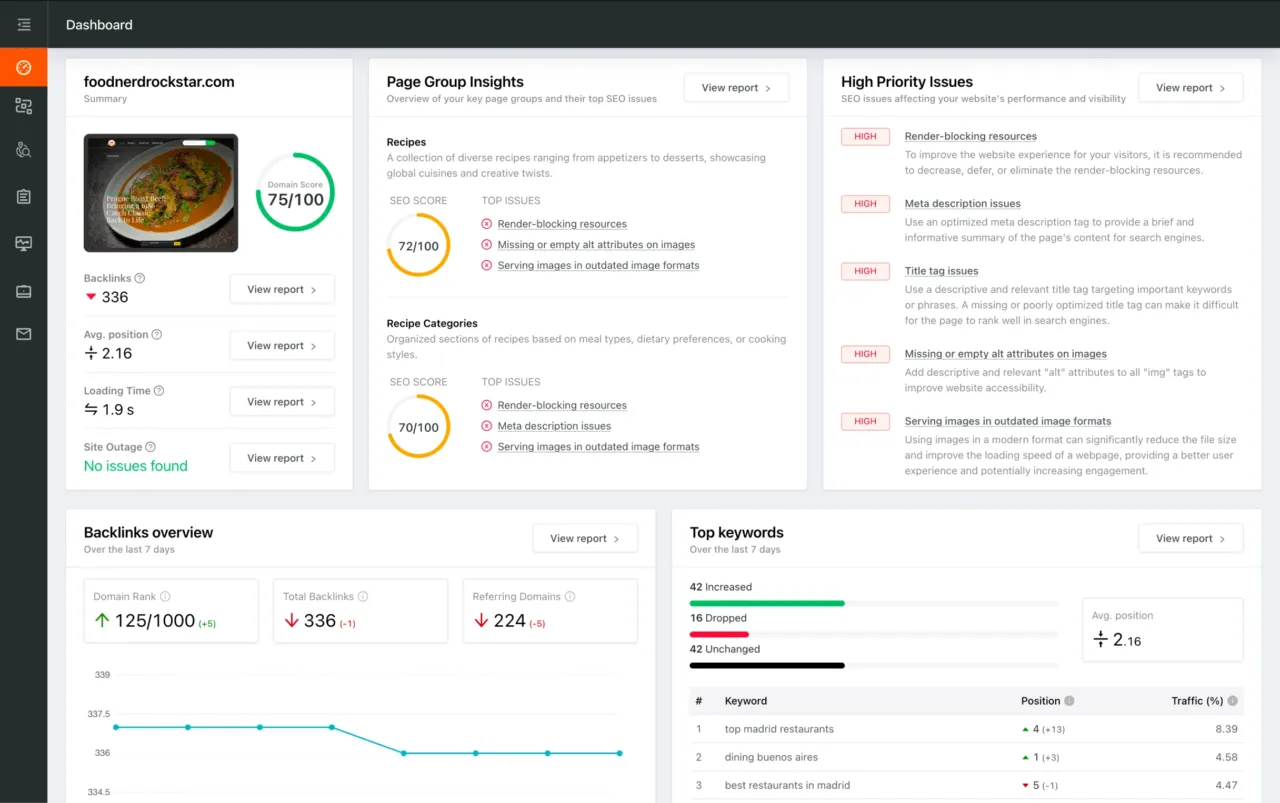
A practical monthly dashboard may include:
• Overall and unbranded mention rate
• Prompt coverage
• AI share of voice
• Citation rate
• Average prominence score
• Positive, neutral, mixed, and negative sentiment
• Factual accuracy rate
• Top cited first-party pages
• Most frequently cited third-party domains
• AI referral sessions and conversions
• Largest gains, losses, and accuracy risks
Monthly measurement is appropriate for many organizations. Weekly testing may be useful during launches, reputation problems, major content campaigns, or rapidly changing industry events.
When visibility is weak, examine the underlying information environment. Determine which competitors appear, what attributes the answers associate with them, and which sources support those conclusions. Look for missing content, unclear positioning, technical accessibility problems, inconsistent business information, or limited independent coverage.
Prioritize improvements that help users as well as AI systems. Publish direct answers to important customer questions, original research, expert commentary, accurate product information, detailed comparisons, and evidence-supported claims. Keep important information accessible in readable page content and update outdated third-party profiles where possible.
Google states that established SEO practices remain relevant to its generative Search features. Pages must be indexed and eligible for Google Search, but inclusion is not guaranteed. OpenAI similarly explains that allowing OAI-SearchBot helps make public content eligible for ChatGPT search, without guaranteeing placement.
After making changes, repeat the same prompt set under comparable conditions. Evaluate trends across several periods instead of claiming that one update caused an immediate change. Model updates, competitor activity, newly indexed pages, retrieval differences, and normal answer variation may also affect results.
COMMON AI VISIBILITY MEASUREMENT MISTAKES
The first mistake is treating a single answer as a stable ranking. AI responses can change between tests, even when the same prompt is used.
The second is tracking only branded questions. These reveal accuracy and sentiment but do not show whether your company appears during unbranded discovery.
The third is combining mentions, recommendations, and citations into one number. Each represents a different type of visibility and should be reported separately.
Another mistake is ignoring negative or inaccurate appearances. A dashboard focused only on total mentions can make harmful visibility appear successful.
Teams should also avoid changing their prompt set or scoring rules without documenting the change. Period-over-period comparisons are unreliable when the underlying test design has changed.
Finally, referral traffic should not be treated as a complete measure of AI influence. It captures only the visits that analytics tools can identify, not every user affected by an AI-generated answer.
FREQUENTLY ASKED QUESTIONS
How often should AI visibility be measured?
Monthly testing works for many businesses. Weekly monitoring may be appropriate during launches, reputation events, or fast-moving campaigns. The same core prompts and scoring standards should be maintained across reporting periods.
What is a good AI brand mention rate?
There is no universal benchmark. A useful mention rate depends on the industry, competitive environment, prompt set, platform mix, brand maturity, and customer intent. Compare the brand with relevant competitors and its own historical baseline.
Are citations more valuable than brand mentions?
They measure different outcomes. Citations can demonstrate that a website is being used as a source, while mentions show that the brand appears in the generated response. A brand can receive one without the other.
Can AI visibility be measured using website analytics alone?
No. Analytics can identify some referral visits, but it cannot show every answer in which the brand appeared or capture all AI-influenced journeys. Prompt monitoring, answer review, analytics, and customer feedback should be combined.
Does appearing in an AI answer mean the platform endorses the brand?
No. A mention or citation is not automatically an endorsement. The assistant may be providing an example, comparison, supporting source, criticism, or factual reference. Review the context of every appearance.
FINAL TAKEAWAY: MEASURE VISIBILITY, CONTEXT, AND BUSINESS IMPACT
Measuring your brand’s visibility in AI answers requires more than counting how often its name appears. A reliable program evaluates mention rate, prompt coverage, share of voice, citations, prominence, sentiment, factual accuracy, referral traffic, and conversions.
Begin with 25 to 50 representative prompts, run them consistently across the platforms your customers use, and preserve prompt-level evidence. Keep branded and unbranded results separate, compare performance with relevant competitors, and examine each platform individually.
Once the baseline is complete, identify missing topics, weak source coverage, inaccurate descriptions, and competitors receiving stronger visibility. Improve the underlying information, repeat the same tests, and evaluate progress across multiple reporting periods. The objective is not simply to generate more mentions. It is to earn accurate, prominent, relevant visibility that supports customer trust and measurable business outcomes.