Archived

SEO Report for https://www.beta.fidelity.com.tw/index.html

Your general SEO Checkup Score


SEO Score48/100
Average SEO score of top 100 sites: 75%This value indicates the average SEO score of the top 100 most visited websites in the US (in the past 12 months)

Your site scored 48/100, well below the 75 average for top sites. We found 10 issues to fix, and they're costing you traffic right now.

10 Failed
0 Warnings
16 Passed

Want to fix these issues and track your progress?

Common SEO issues
Score:71
Failed:2
Warnings:0
Passed:7
Google Search Results Preview
Desktop version
https://www.beta.fidelity.com.tw/index.html基金投資規劃 | 投資理財網 | 富達投信 | 富達台灣富達重視您的長期報酬,為您提供各種專業基金產品,包括債券、全球入息、股票及多重資產等,並會按不同財務目標,為其提供最全面的投資分析及諮詢意見,致力助您把握投資先機。
Mobile version
https://www.beta.fidelity.com.tw/index.html基金投資規劃 | 投資理財網 | 富達投信 | 富達台灣富達重視您的長期報酬,為您提供各種專業基金產品,包括債券、全球入息、股票及多重資產等,並會按不同財務目標,為其提供最全面的投資分析及諮詢意見,致力助您把握投資先機。
Check how your page might appear in Google search results. Google search results typically uses your webpage title, url and meta-description in order to display relevant summarized information about your site. If these elements are too long, Google will truncate their content. Webpage title up to 70 characters in length, and webpage descriptions up to 160 characters in length are recommended in order to optimize readability.
Keywords Cloud
collins
content
cookie政策
ecb鴿派言論
fidelity
fidelity富達
international
limited
limited之商標。fil
title
「富達投信獨立經營管理」各基金經金管會核准或同意生效,惟不表示絕無風險,基金經理公司以往之經理績效不保證基金之最低投資收益;基金經理公司除盡善良管理人之注意義務外,不負責各基金之盈虧,亦不保證最低之收益,投資人申購前應詳閱基金公開說明書。
中國十九大啟示:創新與題材
中國第次全國代表大會於今日召開,市場焦點已轉向將決定中國未來年發展方向的一系列政策上,包括去槓桿、控債務、確保房地產市場穩定發展以及工業改造,提升企
了解更多
亞洲市場
亞洲高收益
以您的財務需求為核心的投資策略
依金管會規定,境外基金投資大陸地區證券市場之有價證券及銀行間債券市場為限,且投資前述有價證券總金額不得超過該基金淨資產價值之%,當該基金投資地區包含中國大陸及香港,基金淨值可能因為大陸地區之法令、政治或經濟環境改變而受不同程度之影響
個人資料保護法告知事項
債券價格與利率呈反向變動,當利率下跌,債券價格將上揚;而當利率上升,債券價格將會走跌。
債券市場
債市觀點:亞洲高收益債指數表現佳
加上其f標章為fil
加持內需
只需投資,美元或以上,即可成為富達智富理財客戶,專享多項獨有的優惠待遇。
台北市信義區忠孝東路五段號樓
在台投資%之子公司。
基金淨值可能因市場因素而上下波動。投資人於獲配息時,宜一併注意基金淨值之變動。月配息型、【穩定月配息】a類股、a股穩定月配息/避險、a股h月配息澳幣避險及a股c月配息進行配息前未先扣除應負擔之相關費用。基金近
境內基金交易
境外基金交易
大體而言,明年歐洲央行宣佈逐漸縮減量化寬鬆,普遍符合市場預期,鴿式減債策略,帶動歐元走軟、歐股漲。
富達
富達國際
富達基金(台灣)有限公司。版權所有,不得轉載。
富達智富理財
富達證券投資信託股份有限公司
市場研究
年月日
年月日bryan
您的投資一切由您主導。了解更多由我們提供的一系列基金選擇及服務。
投信基金若受益人於申購日(含)起日內申請買回受益憑證,且申請買回時本基金業已成立,每受益權單位之買回費用為其買回申請日之次一營業日每受益權單位淨資產價值之.%。上述買回費用將於受益人之買回價金中扣除。基金經理費、保管費、買回費用以及其他費用將直接反映於基金淨值中。
投資人因不同時間進場,將有不同之投資績效,過去之績效亦不代表未來績效之保證。
投資共建未來
投資宣導專區
投資就像飛龍在天,時而騰躍,緊抓成長大趨勢,時而神隱,由強力研究團隊領航,提高防禦力,才能展現王者風範。亞洲高收益債市,正值雲聚龍騰之際,富達專家為你娓娓
投資新興市場可能比投資已開發國家有較大的價格波動及流動性較低的風險。投資人應選擇適合自身風險承受度之投資標的。
智富理財
月配息型、a類股穩定月配息、【穩定月配息】a類股、a股穩定月配息/避險、a股h月配息澳幣避險及a股c月配息之配息可能由基金的收益或本金中支付。任何涉及由本金支出的部份,可能導致原始投資金額減損。其主旨是,只有在維持穩定配息時,基金的股息才會由本金部份支出。但請注意每股股息並非固定不變。基金配息率不代表基金報酬率,且過去配息率不代表未來配息率
服務電話
本文提及之經濟走勢預測不必然代表本基金之績效,本基金投資風險請詳閱基金公開說明書。投資人應注意投資必有因利率及匯率變動、市場走向、經濟及政治因素而產生之投資風險。當基金投資於外幣計算之證券,以台幣為基礎之投資人便承受匯率風險。富達並不針對個人狀況提供投資建議,投資人應審慎考量本身之投資風險,自行作投資判斷,並應就投資結果自負其責。
查看更多
查詢。a股c月配息僅適合瞭解與接受以下說明的投資人:本金支付的股息代表原始投入本金的報酬或部分金額退還,或原始投資產生的任何資本利得。配息可能導致基金每股資產淨值,以及可供未來投資使用的基金本金立即減少。本金成長幅度可能縮減,高配息不代表投資人總投資的正報酬或高報酬。
查詢,或請洽富達投信或銷售機構索取。
歐元走軟
歐洲市場
激勵歐股
為富達國際有限公司。富達投信為fil
王者債臨
精選市場研究
網路使用安全須知
線上交易
美國公債殖利率在企業財報亮眼與經濟數據表現優於預期等因素影響下,公債殖利率持續飆升。
聯絡我們
股票入息基金投資之企業,其股利(股息)配發時間及金額視個別企業之決定(例如:該企業一年可能集中於一或兩次配發),故每月配息金額的決定主要乃是透過對投資組合企業長期股利配發記錄的追蹤作未來一年股利金額的保守預估,並考量相關稅負後,方決定每月基金每單位的配息金額。
與fidelity
讓您的財富更上一樓
重要法律聲明
關注我們
高收益債券基金適合尋求投資固定收益之潛在收益且能承受較高風險之非保守型投資人;投資人投資以高收益債券為訴求之基金不宜占其投資組合過高之比重,由於高收益債券之信用評等未達投資等級或未經信用評等,且對利率變動的敏感度甚高,高收益債券基金可能會因利率上升、市場流動性下降,或債券發行機構違約不支付本金、利息或破產而蒙受虧損,投資人應審慎評估。高收益債券基金不適合無法承擔相關風險之投資人。
The Keyword Cloud is a visual representation of keywords used on your website. This will show you which words are frequently used in the content of your webpage. Keywords having higher density are presented in larger fonts and displayed in alphabetic order.
Competitor Domains Test
Competitor Domains

Understand your competitors' SEO and backlink profile

Get related competitors and their domain authority score in relation to your domain.

Identifies up to ten domains that compete for similar organic search results, ranked by overall domain authority based on the volume and quality of their backlink profiles. Useful for benchmarking the competitive landscape and prioritizing which sites to study for content and link-building strategy.
Robots.txt Test
Your site lacks a "robots.txt" file. This file can protect private content from appearing online, save bandwidth, and lower load time on your server. A missing "robots.txt" file also generates additional errors in your apache log whenever robots request one. Read more about the robots.txt file, and how to create one for your site.

Robots.txt Test

How to pass this test?

In order to pass this test you must create and properly install a robots.txt file.
For this, you can use any program that produces a text file or you can use an online tool (Google Webmaster Tools has this feature).
Remember to use all lower case for the filename: robots.txt, not ROBOTS.TXT.
A simple robots.txt file looks like this:
User-agent: *
Disallow: /cgi-bin/
Disallow: /images/
Disallow: /pages/thankyou.html
This would block all search engine robots from visiting "cgi-bin" and "images" directories and the page "http://www.yoursite.com/pages/thankyou.html"

TIPS:
  • You need a separate Disallow line for every URL prefix you want to exclude
  • You may not have blank lines in a record because they are used to delimit multiple records
  • Notice that before the Disallow command, you have the command: User-agent: *. The User-agent: part specifies which robot you want to block. Major known crawlers are: Googlebot (Google), Googlebot-Image (Google Image Search), Baiduspider (Baidu), Bingbot (Bing)
  • One important thing to know if you are creating your own robots.txt file is that although the wildcard (*) is used in the User-agent line (meaning "any robot"), it is not allowed in the Disallow line.
  • Regular expressions are not supported in either the User-agent or Disallow lines
Once you have your robots.txt file, you can upload it in the top-level directory of your web server. After that, make sure you set the permissions on the file so that visitors (like search engines) can read it.
Check if your website is using a robots.txt file. When search engine robots crawl a website, they typically first access a site's robots.txt file. Robots.txt tells Googlebot and other crawlers what is and is not allowed to be crawled on your site.
Sitemap Test
Your site lacks a sitemap file. Sitemaps can help robots index your content more thoroughly and quickly. Read more on Google's guidelines for implementing the sitemap protocol.

Sitemap Test

How to pass this test?

In order to pass this test you must create a sitemap.xml file for your website. Some of the best practices are listed below:
  • It is strongly recommended that you place your sitemap at the root directory of your website: http://yourwebsite.com/sitemap.xml But in some situations, you may want to produce different sitemaps for different paths on your site (e.g., security permission issues)
  • Sitemaps should be no larger than 10MB (10,485,760 bytes) and can contain a maximum of 50,000 URLs. This means that if your site contains more than 50,000 URLs or your sitemap is bigger than 10MB, you must create multiple sitemap files and use a Sitemap index file
  • All URLs listed in the sitemap must reside on the same host as the sitemap. For instance, if the sitemap is located at http://www.yourwebsite.com/sitemap.xml, it can't include URLs from http://subdomain.yourwebsite.com
  • Once you have created your sitemap, let search engines know about it by submitting directly to them, pinging them, or adding the sitemap location to your robots.txt file
  • Sitemaps can be compressed using gzip, reducing bandwidth consumption
sitemap.xml example:
<?xml version="1.0" encoding="UTF-8"?>
<urlset xmlns="http://www.sitemaps.org/schemas/sitemap/0.9">
<url>
 <loc>http://www.yourwebsite.com</loc>
 <lastmod>2013-01-01</lastmod>
 <changefreq>weekly</changefreq>
 <priority>0.9</priority>
</url>
<url>
 <loc>http://www.yourwebsite.com/articles/100</loc>
 <changefreq>weekly</changefreq>
</url>
<url>
 <loc>http://www.yourwebsite.com/articles/101</loc>
 <lastmod>2013-01-02</lastmod>
 <changefreq>weekly</changefreq>
</url>
<url>
 <loc>http://www.yourwebsite.com/articles/102</loc>
 <lastmod>2013-01-02T13:00:12+00:00</lastmod>
 <priority>0.5</priority>
</url>
</urlset>
Check if the website has a sitemap. A sitemap is important as it lists all the web pages of the site and let search engine crawlers to crawl the website more intelligently. A sitemap also provides valuable metadata for each webpage.
Image Alt Test
Your webpage has 7 'img' tags and all of them contain the required 'alt' attribute.
Check if images on your webpage are using alt attributes. If an image cannot be displayed (e.g., due to broken image source, slow internet connection, etc), the alt attribute provides alternative information. Using relevant keywords and text in the alt attribute can help both users and search engines better interpret the subject of an image.
Deprecated HTML Tags
Congratulations! Your page does not use HTML deprecated tags.
Check if your webpage is using old, deprecated HTML tags. These tags will eventually lose browser support and your web pages may render incorrectly as browsers drop support for these tags.
Google Analytics Test
Congratulations! Your website is using the latest version of Google Analytics.
Check if your website is connected with Google Analytics. Google Analytics is a popular, free website analysis tool that helps provide insights about your site's traffic and demographics.
Favicon Test
favicon
Congratulations! Your website appears to have a favicon.
Check if your site is using and correctly implementing a favicon. Favicons are small icons that appear in your browser's URL navigation bar. They are also saved next to your URL's title when your page is bookmarked. This helps brand your site and make it easy for users to navigate to your site among a list of bookmarks.
JS Error Checker
Congratulations! There are no severe JavaScript errors on your web page.
Check your page for JavaScript errors. These errors may prevent users from properly viewing your pages and impact their user experience. Sites with poor user experience tend to rank worse in search engine results.
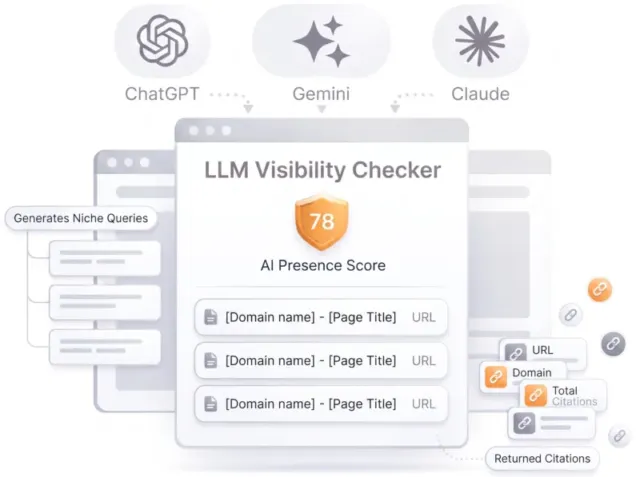
LLM Visibility Checker

LLM Visibility Checker

Track your brand across ChatGPT, Gemini and Claude

Get an AI Presence Score, see which of your pages get cited, and follow how you compare with competitors over time.

Speed optimizations

Score:30
Failed:4
Warnings:0
Passed:2
HTML Page Size Test
Check your page's HTML size. HTML size is the size of all the HTML code on your web page - this size does not include images, external javascripts or external CSS files.
HTML Compression/GZIP Test
Your page do not use any HTML compression!
You should compress your HTML to reduce your page size and page loading times - this will help your site retain visitors and increase page views. If you were using compression, you could be compressing your HTML size by 69 % - from 22.54 Kb to 7.03 Kb which would further reduce your page loading time.
HTML Compression/GZIP Test

How to pass this test?

Your two options for file compression are Deflate and GZIP.
  • Deflate is an option which comes automatically with the Apache server and which is simple to set up.
  • GZIP on the other hand needs to be installed and requires a bit more work to install. However, GZIP does achieve a higher compression rate and therefore might be a better choice if your website uses pages which have a lot of images or large file sizes.
Setting up file compression for your website will depend on which type of server you?re using for your website. Most likely, you?ll be using Apache, which means you can enable compression by adding a few deflate codes to your .htaccess file.
# compress text, html, javascript, css, xml:
AddOutputFilterByType DEFLATE text/plain
AddOutputFilterByType DEFLATE text/html
AddOutputFilterByType DEFLATE text/xml
AddOutputFilterByType DEFLATE text/css
AddOutputFilterByType DEFLATE application/xml
AddOutputFilterByType DEFLATE application/xhtml+xml
AddOutputFilterByType DEFLATE application/rss+xml
AddOutputFilterByType DEFLATE application/javascript
AddOutputFilterByType DEFLATE application/x-javascript
For more advanced information regarding deflate you can check this Apache documentation.
Check if your website is using HTML compression. HTML compression plays an important role in improving website speed by finding similar strings within a text file and replacing them temporarily to reduce overall file size.
Site Loading Speed Test
Your site loading time is around 6.23 seconds and is over the average loading speed which is 5 seconds.
Related Keywords

Accurate historical loading speed monitor and reports

Get detailed and accurate loading speed reports for your websites and see how your pages are being loaded over time.

Check your website's loading speed. Page speed is an important factors in search engine rankings and overall site success. Pages that take longer than 5 seconds to load can lose up to 50% of users. Faster webpages result in higher traffic, better conversions and increased sales over slower loading pages.
Page Objects
Your page has more than 20 http requests, which can slow down page loading. You can try reducing http requests through various methods such as using text instead of images, using css sprites, using data URIs instead of images, or combining several external files together into one.
Total Objects: 28
  • 1 HTML Pages
  • 1 CSS Files
  • 14 JS Files
  • 12 Images
  • 0 Flash Files
Check if all the objects requested by this webpage can be retrieved. If they are not retrievable, your page may display incorrectly, leading to a bad user experience and lower search engine rankings.
Image Caching Test
Your site is not using expires headers for your images. An expires tag can help speed up the serving of your webpages for users that regularly visit your site and see the same images. Learn more about how to add expires headers to your images.

Image Caching Test

How to pass this test?

In order to reduce the number of HTTP requests, you can use the HTTP Expires header to set an expiration time for your images or any other content type. You can add the following lines into your .htaccess file:
<IfModule mod_expires.c>
    ExpiresActive on
 
    ExpiresByType image/jpg "access plus 1 month"
    ExpiresByType image/jpeg "access plus 1 month"
    ExpiresByType image/gif "access plus 1 month"
    ExpiresByType image/png "access plus 1 month"
</IfModule>
Checks if your page is using an image expires tag, which specifies a future expiration date for your images. Users browsers will see this tag and cache the image in their browser until the specified date (so that it does not keep re-fetching the unchanged image from your server). This speeds up your site the next time returning visitors arrive at your site and require the same image.
URL Redirects Checker
Congratulations! Your URL doesn't have any redirects (which could potentially cause site indexation issues and site loading delays).
Check how many redirects your URL will perform to resolve to the final destination URL. Redirects often cause search engine indexing issues and can also lead to some minor loading delays. Google recommends removing or keeping redirects to a minimum.
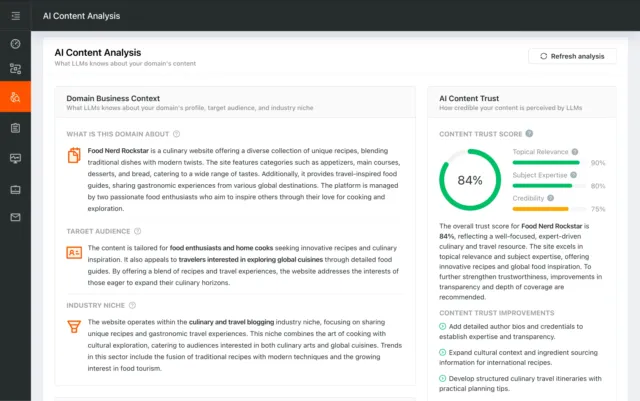
AI Content Analysis

AI Content Analysis

Optimize your content for search and LLMs

AI Content Analysis scores your pages on clarity, depth, and machine readability, so you optimize for both human readers and LLMs.

Server and security

Score:47
Failed:1
Warnings:0
Passed:2
URL Canonicalization Test
https://www.beta.fidelity.com.tw/index.html and https://beta.fidelity.com.tw/index.html should resolve to the same URL, but currently do not.

URL Canonicalization Test

How to pass this test?

In order to pass this test you must consider using a 301 re-write rule in your .htaccess file so that both addresses (http://example.com and http://www.example.com) resolve to the same URL.
- If you want to redirect http://www.example.com to http://example.com, you can use this:
RewriteCond %{HTTP_HOST} ^www\.example\.com$
RewriteRule ^/?$ "http\:\/\/example\.com\/" [R=301,L]
- If you want to redirect http://example.com to http://www.example.com, you can use this:
RewriteCond %{HTTP_HOST} !^www.example.com$ [NC]
RewriteRule ^(.*)$ http://www.example.com/$1 [L,R=301]
Note that you must put the above lines somewhere after RewriteEngine On line.
Test your site for potential URL canonicalization issues. Canonicalization describes how a site can use slightly different URLs for the same page (e.g., if http://www.example.com and http://example.com displays the same page but do not resolve to the same URL). If this happens, search engines may be unsure about which URL is the correct one to index. Learn more about canonicalization issues.
HTTPS Test
Your website is successfully using https, a secure communication protocol over the Internet. Note: if your site relies primarily on ad income, be aware that using https may be detrimental to ad earnings.
Check if your website is using HTTPS, a secure protocol for sending/receiving data over the Internet. Using HTTPS indicates that an additional encryption/authentication layer was added between client and server. HTTPS should be used by any site that collects sensitive customer data such as credit card information. Even for sites that do not collect such data, switching to https helps users by improving privacy and overall security. Google is increasingly using https as a positive ranking factor.
Plaintext Emails Test
Congratulations! Your webpage does not include email addresses in plaintext.
Check your webpage for plaintext email addresses. Any e-mail address posted in public is likely to be automatically collected by computer software used by bulk emailers (a process known as e-mail address harvesting). A spam harvester can read through the pages in your site and extract plaintext email addresses which are then added to bulk marketing databases (resulting in more inbox spam). There are several methods for email obfuscation.
Visual SEO Analysis

Visual SEO Analysis

Find out if your page design converts the visitors you earn

We score six things that decide whether a visitor stays and acts, from the first screen to the path to action, and rank every fix by effort and impact.

Mobile usability

Score:0
Failed:1
Warnings:0
Passed:1
Media Query Responsive Test
Your website is not using media queries. You should consider using this technique in order to implement responsive design functionalities.

Media Query Responsive Test

How to pass this test?

Media queries allow you to style elements for specific devices (smartphones, tablets, desktop computers) by using attributes like width, height, resolution, aspect ratio, orientation or color. By using media queries, presentations can be tailored to a specific range of output devices without changing the content itself.
Example:
<link rel="stylesheet" media="screen and (min-width: 480px) and (max-width: 960px)" 
href="480-960.css" />
 
<!-- OR -->
@media screen and (min-width: 480px) and (max-width: 960px) {
    #header {
        display: none;
    }
}
An @media rule specifies the target media types of a set of statements. In the example above, we are specifying the media type screen. The max-width and min-width features are telling the browser that at any screen size larger than 480px, but smaller than 960px, hide any elements with id="header".
Check if your page implements responsive design functionalities using the media query technique. The '@media' rule allows different style rules for screen sizes. Media query techniques allow different presentation and content to be served depending on the output device, helping ensure that your website renders optimally on all devices and platforms.
Mobile Snapshot
Mobile view
Check how your website renders on a mobile device.

Advanced SEO

Score:60
Failed:2
Warnings:0
Passed:4
Microdata Schema Test
Your webpage doesn't take the advantages of HTML Microdata specifications in order to markup structured data. View Google's guide for getting started with microdata.

Microdata Schema Test

How to pass this test?

HTML5 Microdata is an easy way to add semantic markup to your web pages. Search engines rely on this markup to improve the display of search results, making it easier for people to find the right web pages.
Here is a simple example of how to use HTML5 microdata in your contact web page:
<div itemscope itemtype="http://schema.org/Person">
   <span itemprop="name">Joe Doe</span>
   <span itemprop="company">The Example Company</span>
   <span itemprop="tel">604-555-1234</span>
   <a itemprop="email" href="mailto:joe.doe@example.com">joe.doe@example.com</a>
</div>
Check if your website uses HTML Microdata specifications (or structured data markup). Search engines use microdata to better understand the content of your site and create rich snippets in search results (which helps increase click-through rate to your site).
Noindex Checker
Your webpage does not use the noindex meta tag. This means that your webpage will be read and indexed by search engines.
Check if your webpage is using the robots meta tag or the X-Robots-Tag HTTP header to instruct search engines not to show your site in search results pages.
Canonical Tag Checker
Your page does not use the canonical link tag.
Check if your webpage is using the canonical link tag. The canonical link tag is used to nominate a primary page when you have several pages with duplicate or very similar content.
Nofollow Checker
Your webpage does not use the nofollow meta tag. This means that search engines will crawl all links from your webpage.
Check if your webpage is using the robots meta tag or the X-Robots-Tag HTTP header to instruct search engines not to follow the links on your page. Outgoing links marked with this tag will tell search engines not to follow or crawl that particular link. Google recommends that nofollow tags are used for paid advertisements on your site and links to pages that have not been vetted as trusted sites (e.g., links posted by users of your site).
Disallow Directive Checker
Your site lacks a "robots.txt" file. This file can protect private content from appearing online, save bandwidth, and lower load on your server. A missing "robots.txt" file also generates additional errors in your apache log whenever robots request one.
Check if your robots.txt file is instructing search engine crawlers to avoid parts of your website. The disallow directive is used in robots.txt to tell search engines not to crawl and index a file, page, or directory.
SPF records checker
Your DNS server is not using an SPF record. SPF (Sender Policy Framework) allows administrators to specify which hosts are allowed to send mail from a given domain by creating a specific SPF record or TXT record in the Domain Name System (DNS). You can find more information about SPF records here.

SPF records checker

How to pass this test?

An SPF record is a type of Domain Name Service (DNS) record that allows email systems to check if the sender of a message comes from a legitimate source and refuse an email if the source is not legitimate. Adding an SPF record is as easy as adding CNAME, MX or A records in your DNS zone. You can find more information here.

Before creating the SPF record for your domain, it is important to have access at your domain's DNS zone and to know what mail servers your domain is likely to use and plan how you want any non-authorised email to be handled.

Example:
Let's say that you are planning to send emails using Google Apps and you also want to ensure that no other mail servers are authorised. You can use an SPF record like this:

v=spf1 include:_spf.google.com -all
"v=spf1" - This sets the SPF version
"include:_spf.google.com" - This includes Google mail servers in your list of authorized sending servers
"-all" - This means that any server not previously listed is not authorized

If you are using your own VPS to send email and not any other service like Mandrill, Google Apps, etc. then you can create an SPF record like this:

v=spf1 mx -all

Note:
Setting an SPF record for your domain can help in reducing the chances of a spammer using your domain name in unsolicited emails. Research carefully what mail servers your domain is likely to use and plan how you want any non-authorised email to be handled.
Check if your DNS records contains an SPF record. SPF (Sender Policy Framework) records allow email systems to verify if a given mail server has been authorized to send mail on behalf of your domain. Creating an SPF record increases email delivery rates by reducing the likelihood of your email being marked as spam.

Dominate search today on Google and AI Engines.

Join 85,000+ SaaS Marketers, Growth Agencies, Content-Led Companies and E-commerce Brands.

See Pricing
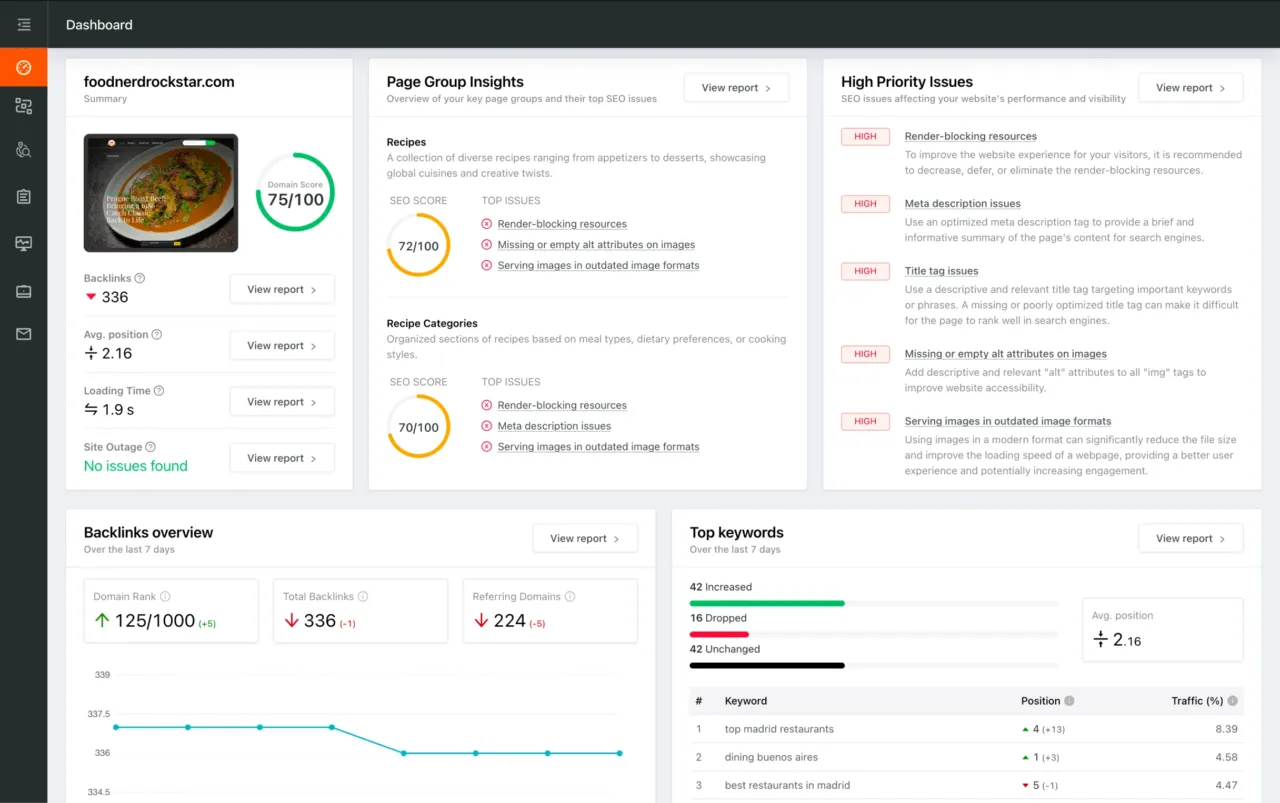
Dashboard preview showing SEO site checkup metrics, page group insights, and issue prioritization