Archived

SEO Report for https://solucionesgrupalia.com

Your general SEO Checkup Score


SEO Score79/100
Average SEO score of top 100 sites: 75%This value indicates the average SEO score of the top 100 most visited websites in the US (in the past 12 months)

Your site scored 79/100, just above the 75 average for top sites. We found 9 issues to fix, and they're what's holding you back from the top spots.

9 Failed
6 Warnings
43 Passed

Want to fix these issues and track your progress?

Issues to fix

HIGH
To improve the website experience for your visitors, it is recommended to eliminate any render-blocking resources on this webpage.
Details
HIGH
Using images in a modern format can significantly reduce the file size and improve the loading speed of a webpage, providing a better user experience and potentially increasing engagement.
Details
MEDIUM
Consider adding cache headers for JavaScript resources to speed up the webpage for returning users.
Details
MEDIUM
Consider adding cache headers for images to improve website performance. With cache headers, browsers can cache images and serve them quickly to returning visitors, rather than re-fetching them each time.
Details
MEDIUM
Add a Google Analytics script to this website to help in diagnosing potential SEO issues by monitoring site visitors and traffic sources.
Details
MEDIUM
Consider adding cache headers for CSS resources to speed up the webpage for returning users.
Details
LOW
Using more than 20 HTTP requests on a webpage can negatively impact the loading time.
Details
LOW
Consider adding the Strict-Transport-Security header to your webpage to ensure that web traffic is encrypted over HTTPS, mitigating the risk of man-in-the-middle attacks and other security threats.
Details

Common SEO issues

Score:90
Failed:1
Warnings:1
Passed:17
Meta Title Test
100% of top 100 sites passed
This webpage is using a title tag.
Text: Poceros en Madrid | Soluciones Grupalia | Empresa de Pocería
Length: 60 characters
The meta title is an HTML element that defines a page's title, displayed in search engine results, browser tabs, and bookmark lists. A concise, keyword-relevant title is a strong on-page ranking signal and a major driver of organic click-through rate. AI answer engines and LLM-driven search experiences also rely on the title to identify, summarize, and cite the page in generative results.
Meta Description Test
92% of top 100 sites passed
This webpage is using a meta description tag with a length of 140 characters. We recommend using well-written and inviting meta descriptions with a length between 150 and 220 characters (spaces included).
Text: Empresa de pocería en Madrid con más de 20 años de experiencia. Poceros profesionales para particulares, comunidades y empresas. 📞911094029.
Length: 140 characters
The meta description is an HTML tag that provides a short summary of a page's content, often shown beneath the title in search results. While not a direct ranking factor, an accurate and inviting description significantly improves click-through rate from organic listings. AI answer engines and social platforms also use it as a trusted summary when generating previews, citations and shareable snippets.
Google Search Results Preview Test
Desktop version
https://solucionesgrupalia.com/Poceros en Madrid | Soluciones Grupalia | Empresa de PoceríaEmpresa de pocería en Madrid con más de 20 años de experiencia. Poceros profesionales para particulares, comunidades y empresas. 📞911094029.
Mobile version
https://solucionesgrupalia.com/Poceros en Madrid | Soluciones Grupalia | Empresa de PoceríaEmpresa de pocería en Madrid con más de 20 años de experiencia. Poceros profesionales para particulares, comunidades y empresas. 📞911094029.
A simulated preview of how the page may appear in Google search results, combining the title, URL, and meta description as Google typically renders them. Useful for spotting truncated text, weak phrasing, or missing elements before publishing, since the snippet directly influences whether searchers click through.
Social Media Meta Tags Test
89% of top 100 sites passed
This webpage is using social media meta tags.
Open Graph Meta Tags
og:localees_ES
og:typewebsite
og:titlePoceros en Madrid | Soluciones Grupalia | Empresa de Pocería
og:descriptionEmpresa de pocería en Madrid con más de 20 años de experiencia. Poceros profesionales para particulares, comunidades y empresas. 📞911094029.
og:urlhttps://solucionesgrupalia.com/
og:site_nameSoluciones Grupalia
Twitter Card Meta Tags
twitter:cardsummary_large_image
Open Graph and Twitter Card meta tags tell social platforms and link unfurlers how to display a page when its URL is shared. Well-formed tags produce richer previews with the intended title, description, and image, which improves click-through on social channels. They also serve as a structured signal that AI crawlers and answer engines can use when summarizing the page.
Most Common Keywords Test
There is likely no optimal keyword density (search engine algorithms have evolved beyond keyword density metrics as a significant ranking factor). It can be useful, however, to note which keywords appear most often on your page and if they reflect the intended topic of your page. More importantly, the keywords on your page should appear within natural sounding and grammatically correct copy.
17madrid
11para
9pocería
9tuberías
8desatascos
A frequency analysis of the most repeated words and phrases in the page's visible content. Useful for getting a quick sense of which topics search engines are likely to associate with the page, and for spotting cases where the actual content drifts from the intended subject.
Keywords Usage Test
48% of top 100 sites passed
The most common keywords of this webpage are distributed well across the important HTML tags. This helps search engines to properly identify the topic of this webpage.
Keyword
Title tag
Meta description
Headings
madrid
para
pocería
tuberías
desatascos
Cross-checks whether the most frequently used keywords on the page also appear in the title and meta description. Alignment between body content and metadata helps search engines confirm the page's topic and reinforces relevance for those terms.
Keywords Cloud Test
agua
alta
antes
arquetas
atasco
atendemos
años
bajantes
cada
camión
capacidad
causa
cerrado
colectores
como
completa
comunidad
comunidades
conforme
contacto
cualquier
cuba
cuánto
cámara
damos
depende
desatasco
desatascos
desde
detección
empezar
empresa
empresas
entre
entregamos
equipo
equipos
experiencia
fosa
fosas
fugas
grupalia
henares
hora
horas
informe
inspección
instalación
interior
limpia
limpiamos
llegar
localizamos
lodos
madrid
maquinaria
naves
normativa
nuestra
obra
obras
orientativos
para
particulares
pocero
poceros
pocería
pozos
precios
presión
presupuesto
problema
provincia
redes
rehabilitación
reparación
residuos
rápida
saneamiento
sede
según
servicio
servicios
sobre
soluciones
séptica
sépticas
teléfono
toda
toledo
trabajamos
trabajo
tubería
tuberías
urgencias
vaciado
vecinos
vivienda
whatsapp
zona
A visual word cloud of the page's content, with more frequent terms shown in larger text. Provides a quick at-a-glance view of which words dominate the page, helping confirm that the visible content reflects the intended topic.
Competitor Domains Test
Competitor Domains

Understand your competitors' SEO and backlink profile

Get related competitors and their domain authority score in relation to your domain.

Identifies up to ten domains that compete for similar organic search results, ranked by overall domain authority based on the volume and quality of their backlink profiles. Useful for benchmarking the competitive landscape and prioritizing which sites to study for content and link-building strategy.
Heading Tags Test
62% of top 100 sites passed
This webpage contains headings tags.
H1 tags
Poceros en Madrid
H2 tags
Servicios de pocería en Madrid
¿Por qué elegir nuestra empresa?
Precios orientativos
Cómo trabajamos
Poceros en toda la Comunidad de Madrid
También trabajamos en Toledo
¿Necesitas un pocero?
Preguntas frecuentes sobre pocería
Inspects the page for H1 and H2 heading tags and reports their structure. Headings give both users and search engines a clear outline of the page's topics, with the H1 acting as the primary subject and H2s framing major sections. A clean heading hierarchy also helps AI answer engines segment the content into discrete passages they can quote or summarize.
Robots.txt Test
99% of top 100 sites passed
This website is using a robots.txt file.
Verifies whether the site exposes a robots.txt file at the root domain. This file is the first resource most crawlers request, telling search engines and other bots which paths they may or may not access. It is also the standard mechanism for allowing or blocking modern AI crawlers used by training pipelines and answer engines.
Sitemap Test
83% of top 100 sites passed
This website has a sitemap file.
Looks for an XML sitemap on the site and reports whether one is published. Sitemaps give search engines an explicit, machine-readable list of the URLs you want crawled, along with metadata such as last-modified dates, which speeds up discovery of new and updated pages. They are especially useful for large sites or those with weak internal linking.
Image Alt Test
78% of top 100 sites passed
All "img" tags from this webpage have the required "alt" attribute.
Inspects whether images on the page include descriptive alt attributes. Alt text provides accessibility for screen readers, a fallback when images fail to load, and a textual signal that helps search engines understand image content. It also improves how AI crawlers and image search tools interpret and surface the visuals.
Responsive Image Test
29% of top 100 sites passed
All images in this webpage are properly sized for different users' viewports.
Compares the natural dimensions of each image to the size at which it is actually rendered in the user's viewport. Serving images significantly larger than needed wastes bandwidth, slows page load, and forces the browser to scale assets unnecessarily, all of which hurt performance and user experience.
Image Aspect Ratio Test
75% of top 100 sites passed
All image display dimensions match the natural aspect ratio.
Compares each image's natural aspect ratio against the ratio at which it is displayed on the page. Significant mismatches result in stretched or squashed visuals that look unprofessional and degrade the user experience.
Deprecated HTML Tags Test
94% of top 100 sites passed
This webpage does not use HTML deprecated tags.
Scans the markup for HTML elements that are no longer part of the modern HTML specification. Deprecated tags may still render today, but browsers can drop support at any time, leading to broken layouts and rendering inconsistencies. Replacing them with current standards keeps the page resilient and easier to maintain.
Google Analytics Test
72% of top 100 sites passed
A Google Analytics script is not detected on this page. While there are several tools available to monitor your site's visitors and traffic sources, Google Analytics is a free, commonly recommended program to help diagnose potential SEO issues.

Google Analytics Test

How to pass this test?

Google Analytics 4 is a free measurement platform that records visitor behavior, traffic sources, and conversion data. Installing it does not directly affect rankings, but the data it produces is essential for measuring SEO performance, identifying high-value pages, and prioritizing future optimization work. Fixing this issue means installing the GA4 tag site-wide and confirming events appear in your reports.

Example

<!-- Place inside <head> on every page -->
<script async src="https://www.googletagmanager.com/gtag/js?id=G-XXXXXXXXXX"></script>
<script>
  window.dataLayer = window.dataLayer || [];
  function gtag(){dataLayer.push(arguments);}
  gtag('js', new Date());
  gtag('config', 'G-XXXXXXXXXX');
</script>

Where to make the change

  • Raw HTML: paste the GA4 snippet into the <head> of every page. A shared layout file is the cleanest place.
  • WordPress: use a site-kit or analytics plugin, or paste the snippet into your theme's header file. Avoid duplicating the tag across multiple plugins.
  • Shopify: add the GA4 measurement ID under Online Store, Preferences, Google Analytics, or install the official Google channel app.
  • Wix or Squarespace: both platforms offer a GA4 measurement ID field in their analytics settings panel.
  • Headless or framework sites: install via Google Tag Manager or use the framework's analytics integration so the tag fires on every route change.

Common causes and how to resolve them

  • Tag not installed at all: install GA4 using the snippet above or the platform-specific path.
  • Universal Analytics tag still in place: Universal Analytics stopped processing data on July 1, 2024. Replace any UA tag (UA-...) with a GA4 measurement ID (G-...).
  • Tag fires only on the homepage: ensure the snippet is in a shared template loaded by every page, not pasted into one post.
  • Cookie banner blocks the tag before consent: integrate Consent Mode v2 so GA4 receives anonymized signals before consent and full data after.
  • Tag duplicated: two snippets on the same page double-count sessions. Audit with the Tag Assistant browser extension and remove duplicates.

Best practices

  • Verify with real-time reports: after installing, open GA4's Realtime view and load the site to confirm events arrive.
  • Use Google Tag Manager: for any site beyond the simplest, GTM gives you a single place to manage analytics, conversion tags, and third-party scripts without code changes.
  • Configure key events: mark conversions (purchase, lead, signup) as key events so reports highlight what matters for SEO ROI.
  • Link to Search Console: connecting GA4 to Search Console surfaces organic queries alongside on-site behavior in the same reports.
Detects whether the page is instrumented with Google Analytics tracking code. Analytics is not an SEO ranking factor, but having reliable traffic and behavior data is essential for measuring the impact of SEO work and identifying opportunities for improvement.
Favicon Test
100% of top 100 sites passed
favicon
This website appears to have a favicon.
Verifies whether the site declares a favicon and that it loads correctly. Favicons appear in browser tabs, bookmarks, and increasingly in search engine result pages, where they reinforce brand recognition and make a listing easier to spot at a glance.
JS Error Test
83% of top 100 sites passed
There are no severe JavaScript errors on this webpage.
Inspects the page for JavaScript runtime errors that occur as it loads. Unhandled errors can break interactive features, leave content unrendered, and signal poor code quality, all of which hurt the user experience that search engines factor into rankings.
Console Errors Test
27% of top 100 sites passed
This webpage doesn't have any warnings or errors caught by the Chrome DevTools Console.
Reviews the browser console for warnings and errors emitted while the page loads. Console messages often expose underlying issues such as failed network requests, deprecated APIs, or security warnings that can quietly degrade the experience even when the page appears to work.
Charset Declaration Test
96% of top 100 sites passed
This webpage has a character encoding declaration.
Content-Type: text/html; charset=UTF-8
Checks whether the page declares a character encoding such as UTF-8. Without an explicit charset declaration, browsers must guess the encoding, which can lead to garbled symbols, broken accented characters, and inconsistent rendering across devices. UTF-8 is the modern standard recommended by Google.
LLM Visibility Checker

LLM Visibility Checker

Track your brand across ChatGPT, Gemini and Claude

Get an AI Presence Score, see which of your pages get cited, and follow how you compare with competitors over time.

Speed optimizations
Score:57
Failed:6
Warnings:4
Passed:10
HTML Page Size Test
23% of top 100 sites passed
The size of this webpage's HTML is 24.51 Kb and is under the average webpage's HTML size of 33 Kb. Faster loading websites result in a better user experience, higher conversion rates, and generally better search engine rankings.
Measures the size of the raw HTML document, excluding images and external CSS or JavaScript. Bloated HTML increases time to first byte and parsing time, slowing down rendering on mobile networks and lower-powered devices. Trimming inline styles, redundant markup, and oversized inline data keeps initial load fast.
DOM Size Test
56% of top 100 sites passed
The Document Object Model (DOM) of this webpage has 356 nodes which is less than the recommended value of 1,500 nodes.
Measures the size and depth of the page's Document Object Model, the tree of nodes the browser builds from the HTML. Very large DOMs increase memory usage, lengthen style and layout calculations, and slow down rendering, particularly on mobile devices. Keeping the DOM lean improves both load time and runtime responsiveness.
HTML Compression/GZIP Test
99% of top 100 sites passed
This webpage is successfully compressed using gzip compression on your code. The HTML code is compressed from 132.77 Kb to 24.51 Kb (82% size savings). This helps ensure a faster loading webpage and improved user experience.
Verifies whether the server delivers the HTML using a compression algorithm such as Gzip or Brotli. Compressed responses dramatically reduce transfer size with negligible decompression cost, translating directly into faster page loads, especially on slower connections.
Site Loading Speed Test
71% of top 100 sites passed
The loading time of this webpage (measured from N. Virginia, US) is around 2.71 seconds and this is under the average loading speed which is 5 seconds.
Related Keywords

Accurate historical loading speed monitor and reports

Get detailed and accurate loading speed reports for your websites and see how your pages are being loaded over time.
Measures the overall time required to load the page in the browser. Page speed is a confirmed Google ranking factor and a strong driver of bounce rate, with slower pages losing a meaningful share of users before they even see the content. Faster pages also tend to convert better, making this a key metric for both SEO and revenue.
JS Execution Time Test
53% of top 100 sites passed
The JavaScript code used by this webpage is executed in less than 2 seconds.
Reports the total time the browser spends parsing, compiling, and executing JavaScript while the page loads. Heavy JavaScript work blocks the main thread and is the primary cause of poor Interaction to Next Paint, the Core Web Vital that replaced First Input Delay in 2024 and that Google uses as part of its ranking algorithms. Reducing bundle size and deferring non-critical scripts directly improves perceived performance.
Page Objects Test
7% of top 100 sites passed
This webpage is using more than 20 http requests, which can slow down page loading and negatively impact user experience!
Content size by content type
Content type
Percent
Size
javascript
41.1 %
492.59 Kb
image
34.5 %
413.25 Kb
css
11.1 %
133.46 Kb
font
9.7 %
116.70 Kb
html
2.6 %
30.94 Kb
other
0.9 %
10.49 Kb
TOTAL
100%
1.17 Mb
Requests by content type
Content type
Percent
Requests
image
29.3 %
17
javascript
27.6 %
16
css
20.7 %
12
other
12.1 %
7
font
6.9 %
4
html
3.4 %
2
TOTAL
100%
58
Content size by domain
Domain
Percent
Size
maps.googleapis.com
38.7 %
463.02 Kb
solucionesgrupalia.com
29.0 %
347.71 Kb
google.com
15.8 %
189.47 Kb
fonts.gstatic.com
9.7 %
116.70 Kb
maps.gstatic.com
6.2 %
74.61 Kb
fonts.googleapis.com
0.5 %
5.50 Kb
places.googleapis.com
0.0 %
427 B
TOTAL
100%
1.17 Mb
Requests by domain
Domain
Percent
Requests
maps.googleapis.com
32.8 %
19
google.com
25.9 %
15
solucionesgrupalia.com
24.1 %
14
fonts.gstatic.com
6.9 %
4
fonts.googleapis.com
5.2 %
3
maps.gstatic.com
3.4 %
2
places.googleapis.com
1.7 %
1
TOTAL
100%
58
Verifies that every resource the page requests, including images, scripts, stylesheets, and fonts, can be successfully retrieved. Broken or unreachable assets can leave the page rendered incorrectly, trigger console errors, and damage both user experience and how search engines perceive page quality.
CDN Usage Test
95% of top 100 sites passed
This webpage is not serving all resources (images, javascript and css) from CDNs!

CDN Usage Test

How to pass this test?

A Content Delivery Network serves static assets from edge locations close to the user, reducing latency, improving cache hit rates, and offloading traffic from the origin server. Fixing this issue means routing your images, JavaScript, CSS, and fonts through a CDN so visitors anywhere in the world get fast, consistent delivery.

Where to make the change

  • Cloud platforms: Cloudflare, Fastly, AWS CloudFront, Bunny.net, and similar providers offer free or low-cost CDN tiers. Sign up, point your domain through the CDN, and enable caching for static asset paths.
  • WordPress: use a CDN integration plugin or sign up directly with Cloudflare and update the site's nameservers.
  • Shopify: Shopify serves storefront assets through its own CDN automatically; the failure usually points at custom assets uploaded outside the platform.
  • Headless or framework sites: deploying to Vercel, Netlify, or Cloudflare Pages puts the entire site behind a global CDN by default.

Common causes and how to resolve them

  • No CDN at all: add one. Even a free Cloudflare account in front of an existing host produces measurable speed gains.
  • CDN configured but bypassed for some assets: ensure all img, script, link, and font URLs use the CDN hostname rather than the origin.
  • Cache headers prevent caching: long-lived assets need cache-control headers like public, max-age=31536000, immutable. Without them, the CDN cannot cache effectively.
  • Origin-only third-party scripts: many vendors already serve their scripts via their own CDN. Use the URL the vendor provides rather than self-hosting.

Best practices

  • Use a versioned asset path: filenames like app.a3f9.css let you set far-future cache headers without ever serving stale files. Update the filename when content changes.
  • Enable Brotli at the edge: most CDNs can compress responses on the fly, including text formats.
  • Pre-warm caches for new launches: after a major release, request key URLs through every region (or use the CDN's purge-and-prefetch tools) so users do not hit cold caches.
Detects whether static assets such as images, JavaScript, and CSS are delivered through a Content Delivery Network. CDNs serve files from edge locations close to the user, reducing latency, improving cache hit rates, and offloading traffic from the origin server. The result is faster, more consistent page performance worldwide.
Modern Image Format Test
43% of top 100 sites passed
This webpage is not serving images in a modern format! Image formats like JPEG 2000, JPEG XR, and WebP often provide better compression than PNG or JPEG, which means faster downloads and less data consumption.

Modern Image Format Test

How to pass this test?

This test fails when images are served in legacy formats such as JPEG and PNG instead of modern alternatives like WebP or AVIF. Modern formats compress significantly better at equivalent visual quality, which means smaller transfers, faster page loads, and lower data usage for visitors on metered connections. Fixing this issue means generating modern variants and serving them to browsers that support them.

Example

<picture>
  <source srcset="/images/hero.avif" type="image/avif">
  <source srcset="/images/hero.webp" type="image/webp">
  <img src="/images/hero.jpg" alt="Marathon runners at sunrise" width="1600" height="900">
</picture>

Where to make the change

  • Raw HTML: use the <picture> element with multiple <source> entries so the browser picks the best supported format.
  • WordPress: WordPress 6.x and later supports WebP natively. Use a media optimization plugin to convert existing JPEGs and PNGs and serve modern formats automatically.
  • Shopify: Shopify's image CDN can serve WebP automatically; using the image_url filter with format parameter or the image_tag helper handles negotiation.
  • Wix or Squarespace: both platforms convert and serve WebP automatically when supported by the visitor's browser.
  • Headless or framework sites: components like next/image and astro:assets generate AVIF and WebP variants at build time and serve the best format per request.

Common causes and how to resolve them

  • Only legacy formats published: add a build step or image CDN that generates WebP and AVIF alongside the original.
  • Single-format <img> tag: wrap the image in <picture> with <source> entries for AVIF and WebP, falling back to the JPEG.
  • Image CDN not negotiating format: enable automatic format conversion or pass a format=auto query parameter (depends on provider).
  • SVG used where a raster image would be smaller (or vice versa): illustrations and icons should be SVG; photos should be raster in a modern format. Mixing them up wastes bytes.

Best practices

  • AVIF first, WebP fallback, JPEG last: AVIF compresses best, WebP is widely supported, JPEG remains the universal fallback.
  • Match quality to use case: hero images can use higher quality settings; thumbnails can drop quality without visible loss.
  • Use an image CDN: services like Cloudflare Images, Cloudinary, or Imgix handle resizing, format conversion, and caching in one step.
Identifies images served in legacy formats such as JPEG and PNG instead of modern alternatives like WebP or AVIF. Modern formats compress significantly better at equivalent visual quality, which means smaller transfers, faster page loads, and lower data usage for visitors on metered connections.
Image Metadata Test
72% of top 100 sites passed
This webpage is not using images with large metadata.
Flags images carrying disproportionately large embedded metadata such as EXIF data, thumbnails, color profiles, geolocation, and camera information. This metadata is rarely useful on the web and adds bytes to every request without any rendering benefit, making it an easy win for shrinking image payloads.
Image Caching Test
95% of top 100 sites passed
This website is not using cache headers for images. Setting cache headers can help speed up the serving of a webpage for returning users. Learn more about how to add expires headers to your images.

Image Caching Test

How to pass this test?

This test fails when image responses lack caching headers that allow browsers to store them for repeat visits. With proper caching directives, returning visitors retrieve images from the local cache instead of refetching them, producing noticeably faster subsequent page loads. Fixing this issue is a server or CDN configuration change.

Where to make the change

  • Server configuration: add Cache-Control headers to image responses. A common setting is Cache-Control: public, max-age=31536000, immutable for versioned assets.
  • CDN configuration: Cloudflare, Fastly, CloudFront, and similar offer rules to set long cache lifetimes for image MIME types.
  • WordPress and plugins: a caching plugin or a CDN integration handles cache headers without server changes.
  • Shopify: Shopify serves images with appropriate cache headers automatically; failures usually point to externally hosted images.

Common causes and how to resolve them

  • No Cache-Control or Expires header: add one. Browsers will revalidate every request without it.
  • Cache-Control: no-cache or no-store: these are correct for HTML responses but wrong for static images. Set a long max-age instead.
  • Short max-age (under a day): images change rarely; a max-age of months or a year is typical.
  • Cookie-bearing image requests: if the image URL sets cookies or varies by user, browsers cannot cache effectively. Serve images from a cookie-free subdomain or your CDN.

Best practices

  • Use versioned filenames: renaming the file when the content changes lets you set near-permanent cache lifetimes without ever serving stale files.
  • Mark immutable assets as such: the immutable directive tells browsers to skip even revalidation requests.
  • Serve from a CDN: CDNs add caching, compression, and edge delivery in one step.
Inspects whether image responses include caching headers that allow browsers to store them for repeat visits. With proper caching directives, returning visitors retrieve images from the local cache instead of refetching them, producing noticeably faster subsequent page loads.
JavaScript Caching Test
96% of top 100 sites passed
This webpage is not using cache headers for JavaScript resources! Setting cache headers can help to speed up the webpage for returning users.

JavaScript Caching Test

How to pass this test?

This test fails when external JavaScript files are served without caching headers that allow browsers to store and reuse them. Cached scripts skip the network on repeat visits, reducing load time and bandwidth for returning users. Fixing this issue is a server or CDN configuration change.

Where to make the change

  • Server configuration: add Cache-Control: public, max-age=31536000, immutable to JavaScript responses, paired with versioned filenames.
  • CDN configuration: set a default cache rule for *.js assets at the edge.
  • Build pipeline: emit hashed filenames (for example app.7f3c1e.js) so cache lifetimes can be long without risking stale code.
  • WordPress and plugins: caching and CDN plugins handle JS cache headers automatically.

Common causes and how to resolve them

  • No Cache-Control header: add one. Without it, browsers revalidate on every page load.
  • Short max-age: bump to a year for versioned files. Use a shorter lifetime only for unversioned scripts that may change in place.
  • no-cache or no-store on static JS: remove these directives; they belong on dynamic responses, not static assets.
  • Cookies on script requests: serve scripts from a cookie-free subdomain or a CDN to enable shared caching.

Best practices

  • Versioned filenames: hashed file names plus immutable caching is the gold standard for cache effectiveness.
  • Self-host critical scripts: hosting third-party scripts yourself lets you control cache headers and avoid vendor outages.
  • Audit with DevTools: the Network panel's "Disk cache" column shows whether each script is genuinely served from cache on repeat visits.
Inspects whether external JavaScript files are served with caching headers that allow browsers to store and reuse them. Cached scripts skip the network on repeat visits, reducing load time and bandwidth for returning users without sacrificing the ability to push fresh code by versioning file URLs.
CSS Caching Test
98% of top 100 sites passed
This webpage is not using cache headers for CSS resources! Setting cache headers can help to speed up the webpage for returning users.

CSS Caching Test

How to pass this test?

This test fails when external CSS files are served without caching headers that allow browsers to store and reuse them. Cached stylesheets skip the network on repeat visits, reducing load time for returning users while still allowing updates through versioned filenames. Fixing this issue is a server or CDN configuration change.

Where to make the change

  • Server configuration: add Cache-Control: public, max-age=31536000, immutable to CSS responses, paired with versioned filenames.
  • CDN configuration: set a default cache rule for *.css assets at the edge.
  • Build pipeline: emit hashed filenames so cache lifetimes can be long without risking stale styles.
  • WordPress and plugins: caching plugins handle CSS cache headers automatically.

Common causes and how to resolve them

  • No Cache-Control header: add one. Without it, browsers revalidate on every page load.
  • Short max-age: bump to a year for versioned files; keep it shorter only for unversioned files that may change in place.
  • Stylesheets behind authentication: private styles cannot use public caching. Move shared styles to a public path.

Best practices

  • Versioned filenames: hashed names plus immutable caching is the gold standard.
  • Inline critical CSS: the styles needed for above-the-fold rendering can be inlined while the rest is cached and loaded asynchronously.
  • Audit with DevTools: confirm that on repeat visits, the stylesheet is served from disk cache rather than the network.
Inspects whether external CSS files are served with caching headers that allow browsers to store and reuse them. Cached stylesheets skip the network on repeat visits, reducing load time for returning users while still allowing updates through versioned filenames.
JavaScript Minification Test
98% of top 100 sites passed
All JavaScript files used by this webpage are minified.
Detects whether external JavaScript files are minified by stripping whitespace, comments, and shortening identifiers. Minified scripts are substantially smaller and faster to download and parse, which lowers page load time and improves Core Web Vitals scores.
CSS Minification Test
100% of top 100 sites passed
All CSS resources used by this webpage are minified.
Detects whether external CSS files are minified by removing whitespace, comments, and unused characters. Minification reduces stylesheet size with no functional change, leading to faster downloads and quicker first render.
Render Blocking Resources Test
15% of top 100 sites passed
This webpage is using render blocking resources! Eliminating render-blocking resources can help this webpage to load significantly faster and will improve the website experience for your visitors.

Render Blocking Resources Test

How to pass this test?

This test fails when JavaScript or CSS resources block the browser from rendering visible content. Each render-blocking file delays the first paint, and on slower networks the cumulative impact can be severe. Fixing this issue means inlining the truly critical CSS, deferring or asynchronously loading non-essential scripts, and removing unused code.

Example

<head>
  <!-- Inline only above-the-fold critical CSS -->
  <style>/* critical styles here */</style>

  <!-- Load full stylesheet asynchronously -->
  <link rel="preload" href="/styles/main.css" as="style"
        onload="this.onload=null;this.rel='stylesheet'">

  <!-- Defer non-critical scripts -->
  <script src="/scripts/app.js" defer></script>
</head>

Where to make the change

  • Application code or templates: identify the CSS and JavaScript needed for the initial render and load only those synchronously. Defer the rest.
  • Build pipeline: use a critical CSS extractor (such as critical or penthouse) to generate the above-the-fold styles automatically.
  • WordPress: performance plugins offer "delay JS execution" and "load CSS asynchronously" options that handle most of this without code changes.
  • Headless or framework sites: use the framework's preload and code-splitting hints to control what blocks rendering.

Common causes and how to resolve them

  • Single large stylesheet blocking render: inline critical CSS for the first viewport, load the full stylesheet asynchronously.
  • Synchronous third-party scripts in the head: add defer or async, or move them to the end of the body.
  • Web fonts blocking text rendering: add font-display: swap in @font-face rules so the fallback font shows immediately.
  • Render-blocking @import in CSS: replace with separate <link rel="stylesheet"> tags so the browser can fetch them in parallel.

Best practices

  • Use defer for scripts that need the DOM: they execute after parsing but before DOMContentLoaded.
  • Use async for fully independent scripts: they execute as soon as they download, in any order.
  • Preload the critical request chain: tell the browser early about fonts and key assets with <link rel="preload">.
  • Audit with Lighthouse: the Render-blocking resources audit lists every offending file with the estimated time saved by deferring it.
Identifies JavaScript and CSS resources that the browser must download and process before it can render visible content. Each render-blocking file delays the first paint, and on slower networks the cumulative impact can be severe. Inlining critical styles, deferring non-essential scripts, and removing unused code all help unblock the rendering path.
URL Redirects Test
97% of top 100 sites passed
This URL doesn't have any redirects (which could potentially cause site indexation issues and site loading delays).
Counts the number of HTTP redirects required for the URL to resolve to its final destination. Each hop adds latency and can dilute link equity, while long redirect chains sometimes confuse crawlers and indexing pipelines. Keeping redirects short and direct is a Google recommendation for both performance and SEO.
Time To First Byte Test
99% of top 100 sites passed
The Time To First Byte value of this webpage is 0.836 seconds. To provide a good user experience, Google recommends that sites should strive to have a TTFB of 0.8 seconds or less.
0.836 s
0.8 s
1.8 s

Time To First Byte Test

How to pass this test?

Time to First Byte (TTFB) measures the delay between the browser requesting the page and the first byte of the response arriving. TTFB reflects backend, network, and CDN performance and effectively sets the floor for every other loading metric, since rendering cannot begin until bytes start flowing. Fixing this issue usually means improving server response time, adding edge caching, or reducing redirect chains.

Where to make the change

  • Server and hosting: upgrade to a faster host plan, move to a region closer to your users, and enable HTTP/2 or HTTP/3.
  • CDN: putting the site behind a CDN dramatically reduces TTFB for users far from the origin server. Cache HTML responses at the edge whenever possible.
  • Application code: profile slow endpoints, cache expensive database queries and external API calls, and use streaming or partial responses.

Common causes and how to resolve them

  • Slow server processing: profile the slowest controllers or routes. Database queries, N+1 loops, and synchronous third-party API calls are typical culprits.
  • No edge caching: caching HTML at the CDN reduces TTFB to a single edge round trip. Use rules to bypass cache for logged-in users.
  • Long redirect chains: each hop adds latency before bytes flow. Collapse chains so the URL the user requests resolves to its final destination in one step.
  • Origin in a distant region: a US-only origin makes Asian users wait. Add edge regions or move the origin closer to the audience.
  • HTTP/1.1 or no keep-alive: upgrading to HTTP/2 or HTTP/3 reduces connection setup overhead.

Best practices

  • Target sub-800 millisecond TTFB at the 75th percentile: Google's recommended threshold for a "good" experience.
  • Cache aggressively: the cheapest server work is the work you never do. Static and semi-static pages should be served from cache.
  • Use HTTP/3 where supported: it eliminates head-of-line blocking and reduces handshake latency, especially on mobile networks.
  • Stream the response when possible: sending the head before the rest of the body lets the browser start fetching subresources earlier.
Measures Time to First Byte, the delay between the browser requesting the page and the first byte of the response arriving. TTFB reflects backend, network, and CDN performance and effectively sets the floor for every other loading metric, since rendering cannot begin until bytes start flowing. Sustained high TTFB usually points to slow server processing, missing edge caching, or inefficient redirects.
First Contentful Paint Test
90% of top 100 sites passed
The First Contentful Paint value of this webpage is 2.208 seconds. To provide a good user experience, Google recommends that sites should strive to have a First Contentful Paint value of 1.8 seconds or less.
2.208 s
1.8 s
3 s

First Contentful Paint Test

How to pass this test?

First Contentful Paint (FCP) measures the time from when the page starts loading to when any part of its content is rendered on the screen. FCP is the user's first visual confirmation that the page is loading, and faster values are strongly correlated with lower bounce rates and better Core Web Vitals scores. Fixing this issue means reducing time to first byte, eliminating render-blocking resources, and serving above-the-fold content without delay.

Where to make the change

  • Server and CDN: reduce TTFB so the browser receives bytes sooner. Edge caching for HTML produces dramatic FCP wins.
  • Application code or templates: inline the critical CSS for above-the-fold content and defer everything not needed for the first paint.
  • Build pipeline: ensure JavaScript bundles are split so the initial load only includes what is needed for first render.

Common causes and how to resolve them

  • Slow TTFB: address the underlying server, redirect, or hosting issue (see Time to First Byte fix).
  • Render-blocking CSS: inline the critical CSS for the first viewport, load the full stylesheet asynchronously.
  • Render-blocking JavaScript in the head: add defer or move scripts to the end of the body.
  • Web fonts delaying text rendering: add font-display: swap so a fallback font is shown immediately while the custom font loads.
  • Heavy hero image without prioritization: add fetchpriority="high" to the hero image and <link rel="preload"> for it in the head.

Best practices

  • Target sub-1.8 second FCP at the 75th percentile: Google's recommended threshold for a "good" experience.
  • Inline critical CSS: the styles needed for the first viewport should not require an extra network round trip.
  • Preload key resources: hero image, key fonts, and critical scripts benefit from explicit preload hints.
  • Defer non-critical work: analytics, chat widgets, and below-the-fold content can wait until after first paint.
Measures First Contentful Paint, the moment when the browser renders the first piece of visible content from the DOM, such as text, an image, or an SVG. FCP is the first signal to the user that the page is actually loading, and faster values are strongly correlated with lower bounce rates and better Core Web Vitals scores.
Largest Contentful Paint Test
77% of top 100 sites passed
The Largest Contentful Paint duration of this webpage is 2.38 seconds. To provide a good user experience, Google recommends that sites should strive to have Largest Contentful Paint of 2.5 seconds or less.
2.38 s
2.5 s
4 s
Largest Contentful Paint element within the viewport:
Text: Poceros en Madrid Somos una empresa de pocería en Madrid con más de 20 años de ...
Html: <div class="kb-row-layout-wrap kb-row-layout-id76_f26fab-b2 al...">
Measures Largest Contentful Paint, the time at which the largest visible element in the viewport, such as a hero image or main heading, finishes rendering. LCP is one of Google's Core Web Vitals and a direct ranking factor, used as a proxy for when the user perceives the page as effectively loaded.
Cumulative Layout Shift Test
91% of top 100 sites passed
The CLS score of this webpage is 0.1290. To provide a good user experience, Google recommends that sites should strive to have a CLS score of 0.1 or less.
0.129
0.1
0.25
DOM element which contributes the most to CLS score:
Score: 0.1290

Cumulative Layout Shift Test

How to pass this test?

Cumulative Layout Shift (CLS) measures the total amount that visible elements move around unexpectedly while the page loads. Layout shifts cause users to misclick and feel the page is unstable, and CLS is one of Google's Core Web Vitals and a direct ranking factor. Fixing this issue means reserving space for everything that loads after first paint so nothing pushes existing content around.

Where to make the change

  • Application code or templates: add explicit width and height (or aspect-ratio CSS) to every image, video, and embed so the browser can reserve space before the asset loads.
  • CSS: use aspect-ratio on responsive containers; use min-height on slots that load content asynchronously (ads, embeds, recommendations).
  • Cookie consent and overlays: render banners as fixed overlays rather than inserting them at the top of the document.

Common causes and how to resolve them

  • Images without dimensions: add width and height attributes (or set aspect-ratio in CSS) so the browser reserves the slot before the image loads.
  • Late-loading web fonts: use font-display: swap with size-adjust and matched fallback metrics so swapping the font does not change line heights.
  • Aggressively injected cookie consent banners: render them as a fixed overlay on top of the layout, not as a block element pushing content down.
  • Ads or embeds inserted without reserved space: reserve a fixed-size container for each slot so the surrounding content does not jump.
  • Animations that move layout-affecting properties: animate transform and opacity instead of top, left, or height.

Best practices

  • Target a CLS score of 0.1 or less at the 75th percentile: the official Core Web Vitals threshold for a "good" experience.
  • Reserve space for everything: if it loads after first paint, give it a fixed slot so it cannot push content.
  • Animate transform only: transform-based animations do not trigger layout and therefore do not produce layout shift.
  • Test on mobile first: small viewports amplify the perceived impact of layout shifts.
Measures Cumulative Layout Shift, the total amount that visible elements move around unexpectedly while the page loads. Layout shifts cause users to misclick and feel the page is unstable, and CLS is one of Google's Core Web Vitals and a direct ranking factor. Common causes include images without explicit dimensions, late-loading fonts, and aggressively injected overlays such as cookie consent banners.
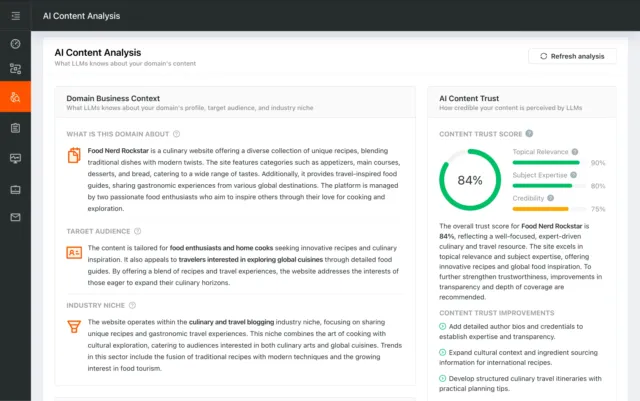
AI Content Analysis

AI Content Analysis

Optimize your content for search and LLMs

AI Content Analysis scores your pages on clarity, depth, and machine readability, so you optimize for both human readers and LLMs.

Server and security

Score:95
Failed:2
Warnings:0
Passed:5
URL Canonicalization Test
93% of top 100 sites passed
Detects whether different URL variants of the site, such as the apex domain and the www subdomain or HTTP and HTTPS, all resolve consistently to a single canonical version. When the same content is reachable at multiple URLs without proper redirects, search engines may split ranking signals across the variants and become unsure which one to index.
SSL Checker and HTTPS Test
100% of top 100 sites passed
This website is successfully using HTTPS, a secure communication protocol over the Internet.
The certificate is not used before the activation date.
The certificate has not expired.
The hostname "solucionesgrupalia.com" is correctly listed in the certificate.
The certificate should be trusted by all major web browsers.
The certificate was not revoked.
The certificate was signed with a secure hash.
Certificate Chain:
Server certificate
Common Name
*.solucionesgrupalia.com
Subject Alternative Names
*.solucionesgrupalia.com, solucionesgrupalia.com
Not Valid Before
Mon, June 22, 2026 at 12:00:00 AM UTC
Not Valid After
Sat, December 19, 2026 at 11:59:59 PM UTC
Signature Algorithm
sha256WithRsaEncryption
Issuer
Sectigo Public Server Authentication CA DV R36
Intermediate certificate
Common Name
Sectigo Public Server Authentication CA DV R36
Organization
Sectigo Limited
Location
GB
Not Valid Before
Mon, March 22, 2021 at 12:00:00 AM UTC
Not Valid After
Fri, March 21, 2036 at 11:59:59 PM UTC
Signature Algorithm
sha384WithRsaEncryption
Issuer
Sectigo Public Server Authentication Root R46
Root certificate
Common Name
Sectigo Public Server Authentication Root R46
Organization
Sectigo Limited
Location
GB
Not Valid Before
Mon, March 22, 2021 at 12:00:00 AM UTC
Not Valid After
Wed, March 21, 2046 at 11:59:59 PM UTC
Signature Algorithm
sha384WithRsaEncryption
Issuer
Sectigo Public Server Authentication Root R46
Verifies whether the site is served over HTTPS with a valid TLS certificate. HTTPS encrypts the connection between visitor and server, protecting credentials and other sensitive data in transit, and Google has used it as a positive ranking signal since 2014. Modern browsers also flag non-HTTPS pages as Not Secure, which damages user trust.
Mixed Content Test (HTTP over HTTPS)
100% of top 100 sites passed
This webpage does not use mixed content - both the initial HTML and all other resources are loaded over HTTPS.
Detects whether a page served over HTTPS is loading any sub-resources such as images, scripts, or stylesheets over insecure HTTP. Mixed content weakens the security guarantees of HTTPS, and modern browsers either block the resources outright or warn the user, often breaking the page in the process.
HTTP2 Test
99% of top 100 sites passed
This webpage is using the HTTP/2 protocol.
Verifies whether the page and its resources are delivered over HTTP/2 or newer, rather than the legacy HTTP/1.1 protocol. HTTP/2 introduces multiplexing, header compression, and prioritization, which together reduce latency and allow the browser to load many resources from the same origin far more efficiently.
HSTS Test
84% of top 100 sites passed
This webpage is not using the Strict-Transport-Security header! This is a security header that was created as a way to force the browser to use secure connections when a site is running over HTTPS.

HSTS Test

How to pass this test?

The Strict-Transport-Security (HSTS) response header tells browsers to access the site only over HTTPS, automatically upgrading future requests and refusing to fall back to HTTP. Fixing this issue means configuring the server to send the header on every HTTPS response.

Example

Strict-Transport-Security: max-age=31536000; includeSubDomains; preload

Where to make the change

  • Server configuration: add the header in Nginx (add_header Strict-Transport-Security "max-age=31536000; includeSubDomains" always;), Apache (Header always set Strict-Transport-Security ...), or your application's response middleware.
  • CDN: Cloudflare, Fastly, and CloudFront let you set HSTS at the edge so it applies regardless of origin configuration.
  • Cloud platforms: Netlify and Vercel allow HSTS via headers files (_headers on Netlify, vercel.json on Vercel).

Common causes and how to resolve them

  • Header not sent: add it in the server or CDN config. Confirm in DevTools, Network tab.
  • Header sent only on HTTP responses: HSTS is only honored over HTTPS, so the header must accompany the HTTPS response.
  • Short max-age: a max-age below a few months provides little protection. Bump to a year (31536000) once you are confident HTTPS is stable.
  • includeSubDomains breaking subdomains that lack HTTPS: only add this directive after every subdomain serves HTTPS. Otherwise users will lose access to the HTTP-only ones.

Best practices

  • Start with a short max-age, then ramp up: a one-week max-age lets you back out quickly if something breaks. Increase to a year once stable.
  • Add preload after testing: submit your domain to hstspreload.org so browsers ship with HSTS for your site baked in. Note that removing a preloaded site is slow.
  • Pair with HTTP-to-HTTPS redirects: HSTS only kicks in after a successful HTTPS visit. Until then, redirects do the work.
Checks whether the server sends a Strict-Transport-Security header instructing browsers to only access the site over HTTPS. HSTS protects users from protocol downgrade attacks and accidental exposure to insecure connections, and is a baseline requirement for any site handling sensitive data.
Plaintext Emails Test
97% of top 100 sites passed
We've found 1 email addresses in your page code! We advise you to protect email links in a way that hides them from the spam harvesters.

Plaintext Emails Test

How to pass this test?

This test fails when the page exposes one or more email addresses in plain text. Spam-harvesting bots scrape pages for plaintext addresses and add them to bulk mailing lists. Fixing this issue means obfuscating contact addresses, using a contact form, or rendering them via JavaScript so simple scrapers cannot read them.

Where to make the change

  • Application code or templates: replace plain contact@example.com text with one of the obfuscation techniques below.
  • WordPress: a contact form plugin handles email submissions without exposing the address. Some SEO and security plugins also offer email obfuscation.
  • Shopify, Wix, Squarespace: use the platform's built-in contact form blocks rather than displaying the email address directly.

Common causes and how to resolve them

  • Plain text address in a paragraph or footer: replace with a contact form, an obfuscated rendering (HTML entities, CSS reversal), or a JavaScript-built mailto link.
  • Mailto link with the address visible: the visible text is what bots read. Make the visible text a label like "Email us" while the href still works.
  • Address baked into images is fine for SEO but bad for accessibility: screen readers cannot read it. Pair an image with a contact form instead.

Best practices

  • Prefer contact forms: they reduce spam and make analytics easier.
  • Use HTML entity encoding: writing &#99;&#111;... for the address defeats the simplest scrapers, though sophisticated ones decode it.
  • Render via JavaScript: building the mailto link client-side blocks scrapers that only read static HTML.
  • Consider a Cloudflare-style email obfuscation: some CDNs automatically rewrite plaintext emails to obfuscated equivalents.
Scans the page for email addresses written in plain text. Spambots harvest such addresses to add them to bulk mailing lists, so obfuscating contact emails or replacing them with contact forms helps reduce inbox spam without hiding the address from legitimate visitors.
Visual SEO Analysis

Visual SEO Analysis

Find out if your page design converts the visitors you earn

We score six things that decide whether a visitor stays and acts, from the first screen to the path to action, and rank every fix by effort and impact.

Mobile usability

Score:100
Failed:0
Warnings:0
Passed:3
Meta Viewport Test
92% of top 100 sites passed
This webpage is using a viewport meta tag.
<meta name="viewport" content="width=device-width, initial-scale=1, minimum-scale=1" />

Checks whether the page declares a viewport meta tag that controls how the layout scales on mobile devices. Without it, mobile browsers render the page at a default desktop width and shrink it to fit, producing unreadable text and unusable touch targets. A correct viewport declaration is the foundation of responsive design.
Media Query Responsive Test
98% of top 100 sites passed
This webpage is using CSS media queries, which is the base for responsive design functionalities.
Detects whether the page's stylesheets use CSS media queries to adapt the layout to different screen sizes. Media queries are the primary mechanism for responsive design, allowing typography, spacing, and component arrangement to adjust gracefully from phones to large desktops. Because Google now indexes the web mobile-first, the responsive mobile layout is effectively the version search engines crawl, evaluate, and rank.
Mobile Snapshot Test
Mobile view
A rendered screenshot of how the page appears on a mobile device. Useful for visually confirming that responsive layouts work as intended and for spotting issues such as overflowing content, illegible text, or broken images that automated checks alone may miss.

Advanced SEO

Score:98
Failed:0
Warnings:1
Passed:8
Structured Data Test
66% of top 100 sites passed
This webpage is using structured data.
Inspects the page for structured data markup such as JSON-LD or Microdata that follows schema.org vocabularies. Structured data helps search engines understand entities and relationships on the page, often unlocking rich result features in SERPs such as star ratings, FAQs, recipes, and product cards. It is also a primary signal AI answer engines use to extract precise facts when generating responses.
Custom 404 Error Page Test
80% of top 100 sites passed
This website is using a custom 404 error page. We recommend to have a custom 404 error page in order to improve the website's user experience by letting users know that only a specific page is missing/broken (and not the entire site), providing them helpful links, the opportunity to report bugs, and potentially track the source of broken links.
Detects whether the site serves a branded, helpful page when a requested URL is not found, instead of the browser's generic error screen. A custom 404 keeps users on the site by offering navigation, search, or suggested links, which reduces frustration and protects engagement metrics that influence both UX perception and indirect SEO outcomes.
Noindex Tag Test
99% of top 100 sites passed
This webpage does not use the noindex meta tag. This means that it can be indexed by search engines.
Detects whether the page is being excluded from search engine indexes via a noindex directive in the robots meta tag or X-Robots-Tag HTTP header. A noindex on the wrong page is one of the most common ways important content silently disappears from search results, so verifying its absence on pages meant to rank is critical.
Canonical Tag Test
93% of top 100 sites passed
This webpage is using the canonical link tag. This tag specifies that the URL: https://solucionesgrupalia.com/ is preferred to be used in search results. Please ensure that this specification is correct, as canonical tags are often hard-coded and may not always reflect the latest changes in a site's URL structure.
<link href="https://solucionesgrupalia.com/" rel="canonical"/>
Detects whether the page declares a canonical link tag indicating its preferred URL. Canonical tags consolidate ranking signals across duplicate or near-duplicate URLs onto a single authoritative version, which prevents search engines from splitting authority across variants caused by query parameters, session IDs, or alternate paths. They also help AI crawlers identify the source of truth when citing the page.
Nofollow Tag Test
This webpage does not use the nofollow meta tag. This means that search engines will crawl all links from this webpage.
Detects whether the page applies a nofollow directive, either through a robots meta tag, an X-Robots-Tag header, or per-link rel attributes, that tells search engines not to follow outbound links. Google recommends nofollow for sponsored links and for user-generated content where the linked sites are not vetted, so its presence or absence has real consequences for how link equity flows.
Disallow Directive Test
Your robots.txt file includes a disallow command which instructs search engines to avoid certain parts of your website! You are advised to confirm if access to these resources or pages are intended to be blocked (e.g., if they contain internal-only content or sensitive information).
Surfaces the disallow rules declared in the site's robots.txt file. Disallow directives tell search engine crawlers not to access specific files, paths, or directories, which is useful for keeping admin sections and duplicate content out of indexes but dangerous when applied too broadly, since over-blocking can hide important pages from search.
Meta Refresh Test
98% of top 100 sites passed
This webpage is not using a meta refresh tag.
Detects whether the page uses a meta refresh tag to automatically reload or redirect after a delay. Meta refresh is largely obsolete, hurts accessibility by jumping focus and disorienting screen reader users, and is a weaker signal to search engines than a proper server-side 301 redirect. Its presence usually indicates outdated implementation worth updating.
SPF Records Test
94% of top 100 sites passed
This DNS server is using an SPF record.
v=spf1 include:_spf-eu.ionos.com ~all
Checks the domain's DNS for a Sender Policy Framework record. SPF lets receiving mail servers verify that messages claiming to come from the domain were actually sent by an authorized mail server, which significantly reduces the chance of legitimate email being marked as spam and protects the domain's sender reputation.
Ads.txt Validation Test
67% of top 100 sites passed
This website doesn't use an ads.txt file! Ads.txt is a text file that contains a list of Authorized Digital Sellers. The purpose of ads.txt files is to give advertisers and advertising networks the ability to verify who is allowed to sell advertising on your website.
Validates the format of the site's ads.txt file, which publishers use to declare which advertising vendors are authorized to sell their inventory programmatically. A correctly formatted ads.txt protects against domain spoofing in the ad supply chain and is required for inclusion in many premium advertising marketplaces.

Dominate search today on Google and AI Engines.

Join 85,000+ SaaS Marketers, Growth Agencies, Content-Led Companies and E-commerce Brands.

See Pricing
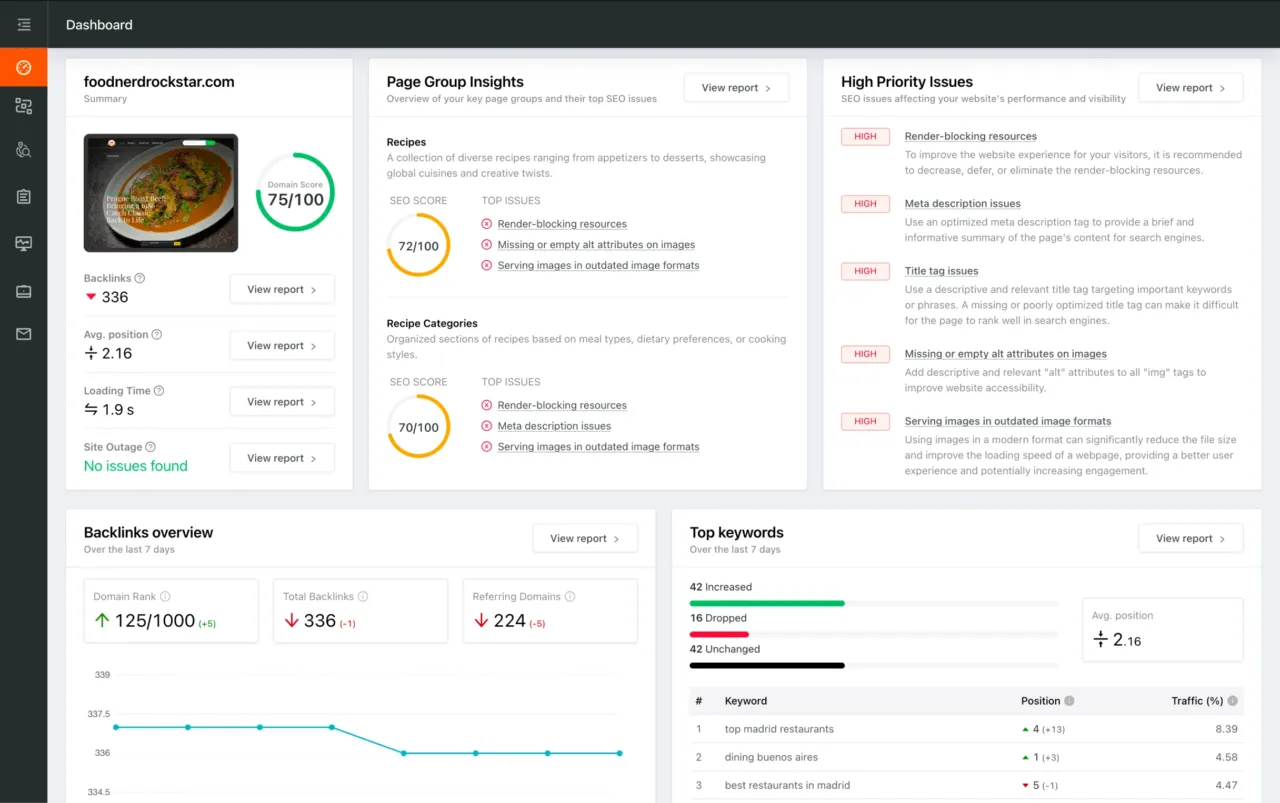
Dashboard preview showing SEO site checkup metrics, page group insights, and issue prioritization